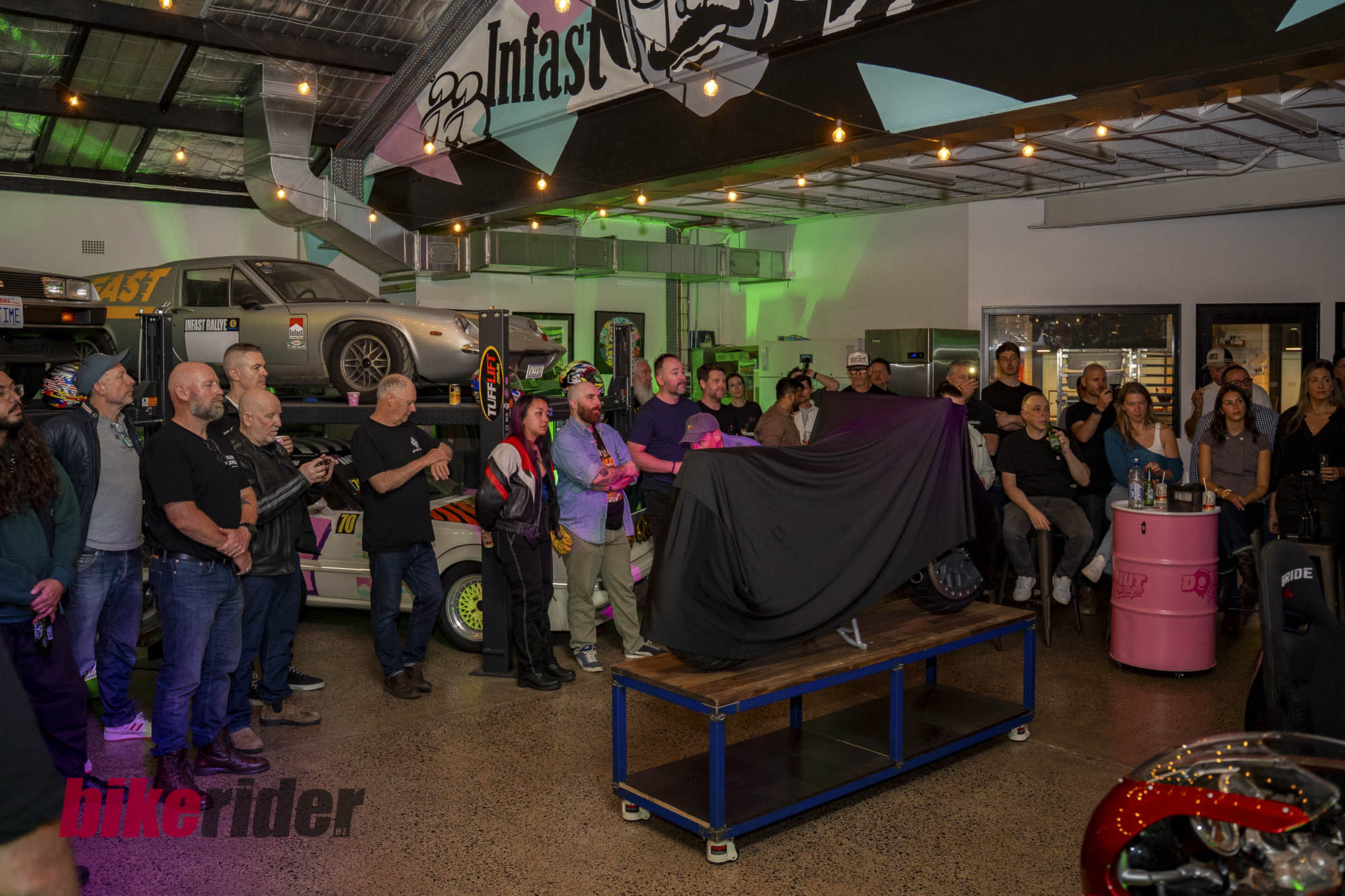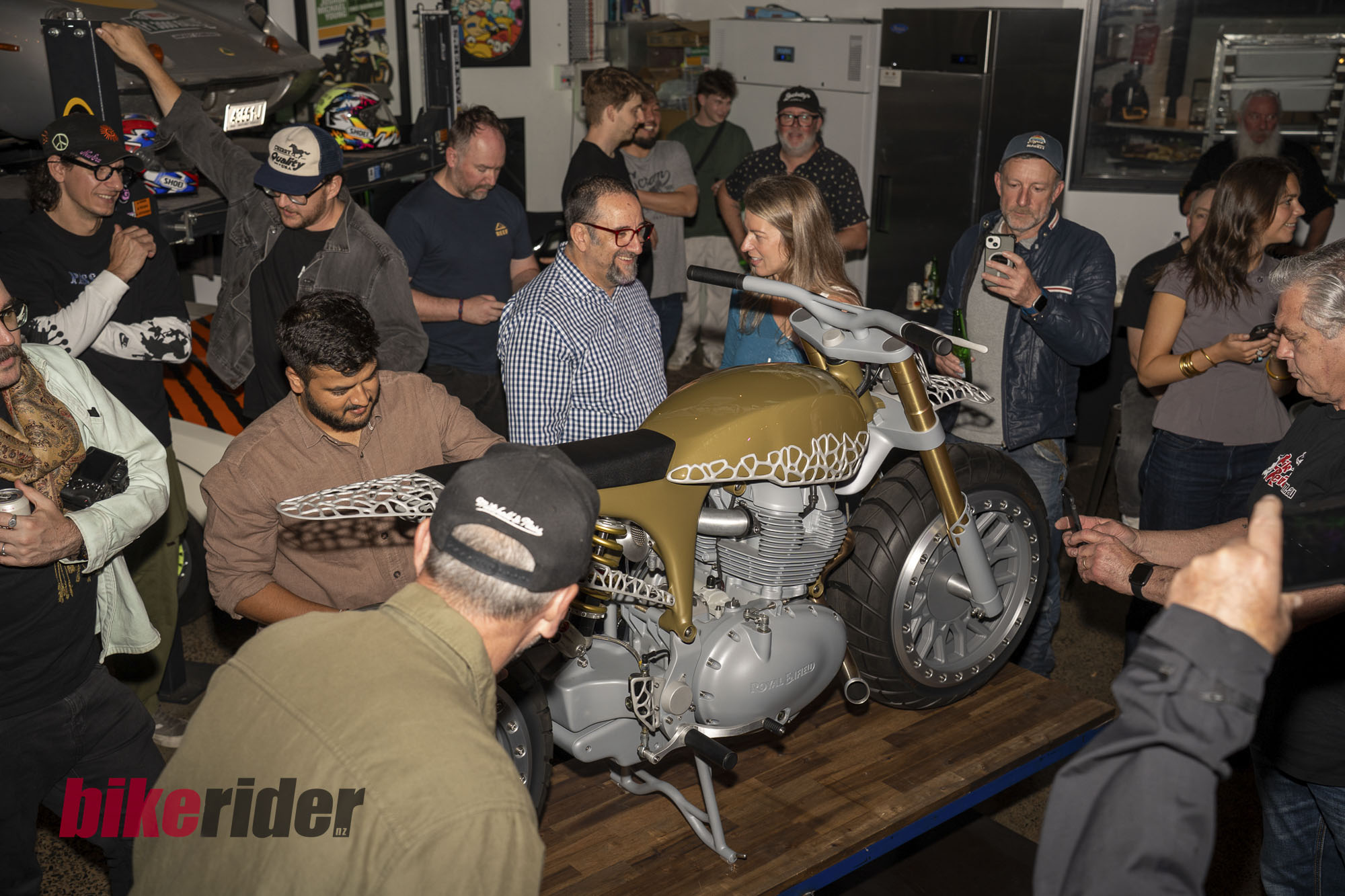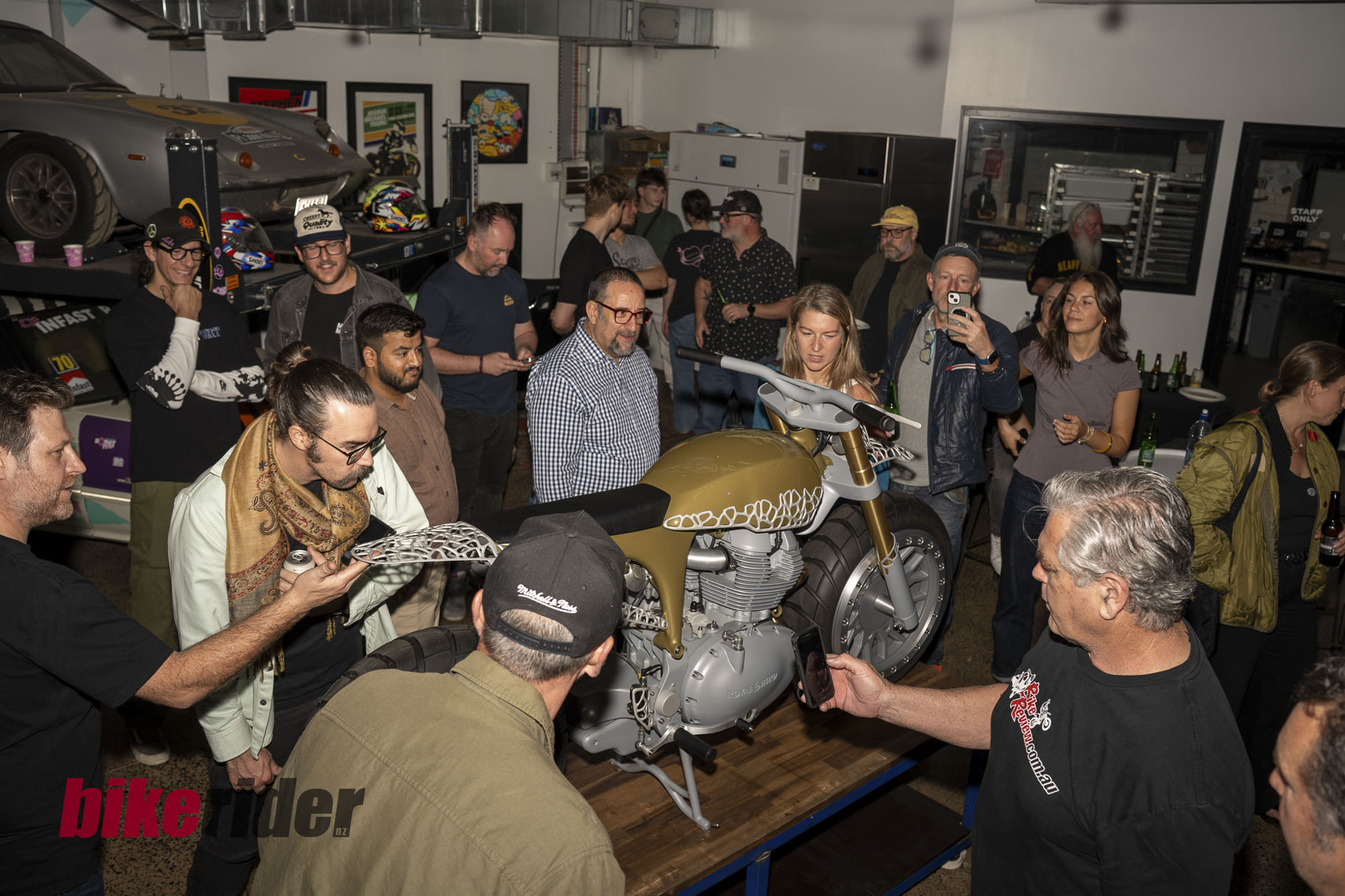


Brisbane’s Black Cycles has transformed a Royal Enfield Bear 650 into a rolling piece of industrial sculpture. Modified 4WD wheels, an aluminium chassis and 600 hours of painstaking fabrication are only half the story.
Photography: Tom Fossati
- Black Cycles built Project MEGA with Pipeburn and Royal Enfield for Custom World.
- Modified 4WD beadlock wheels, a bespoke aluminium frame and a Triumph single-sided swingarm define the build.
- Around 600 hours went into the five-month project, including painstaking hand-cut bodywork.
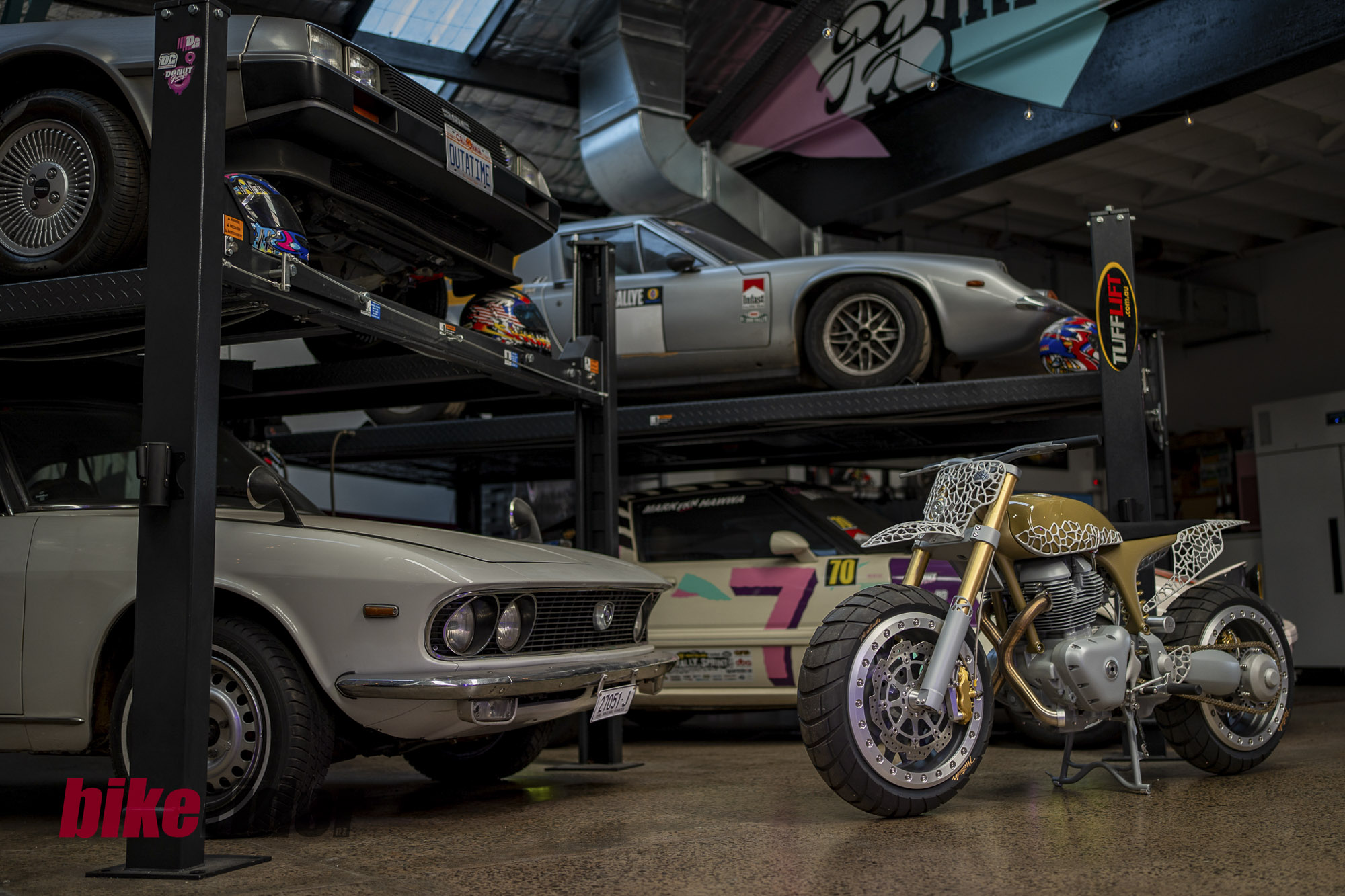
Most custom builds start with a motorcycle and a list of bits to change. Looking at Project MEGA, it might be quicker to list what hasn’t been attacked with a grinder. But this is more than a spectacular collection of handmade parts. It’s one of those rare machines that makes you wonder where motorcycle building ends and art begins.
Art can exist simply to provoke a reaction. A motorcycle, on the other hand, still needs to carry its rider, steer, stop and cope with the road. Noel Muller of Brisbane’s Black Cycles has managed to bring those two worlds together, with a Royal Enfield Bear 650 at the centre of it all. And yes, it runs.
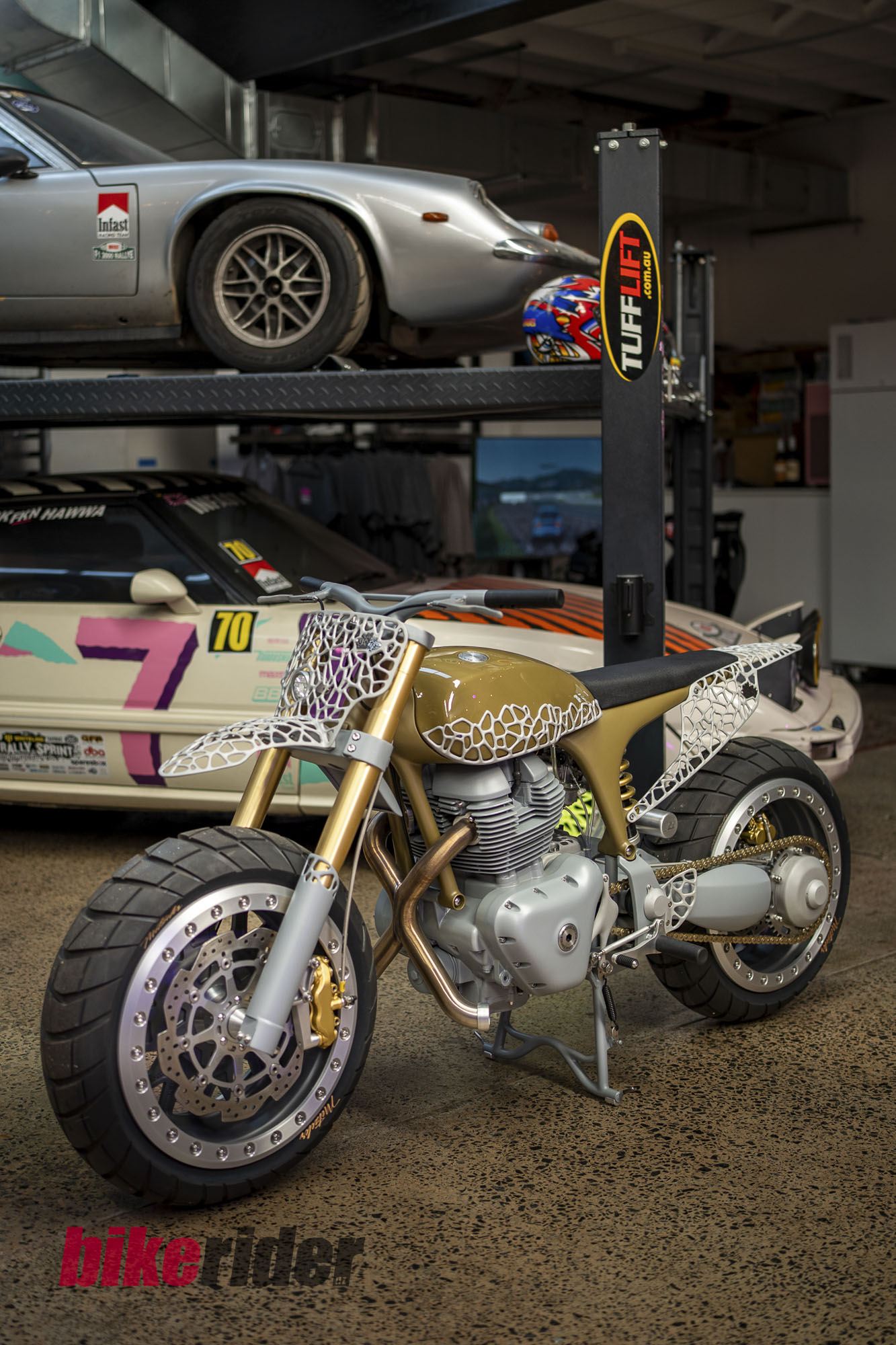
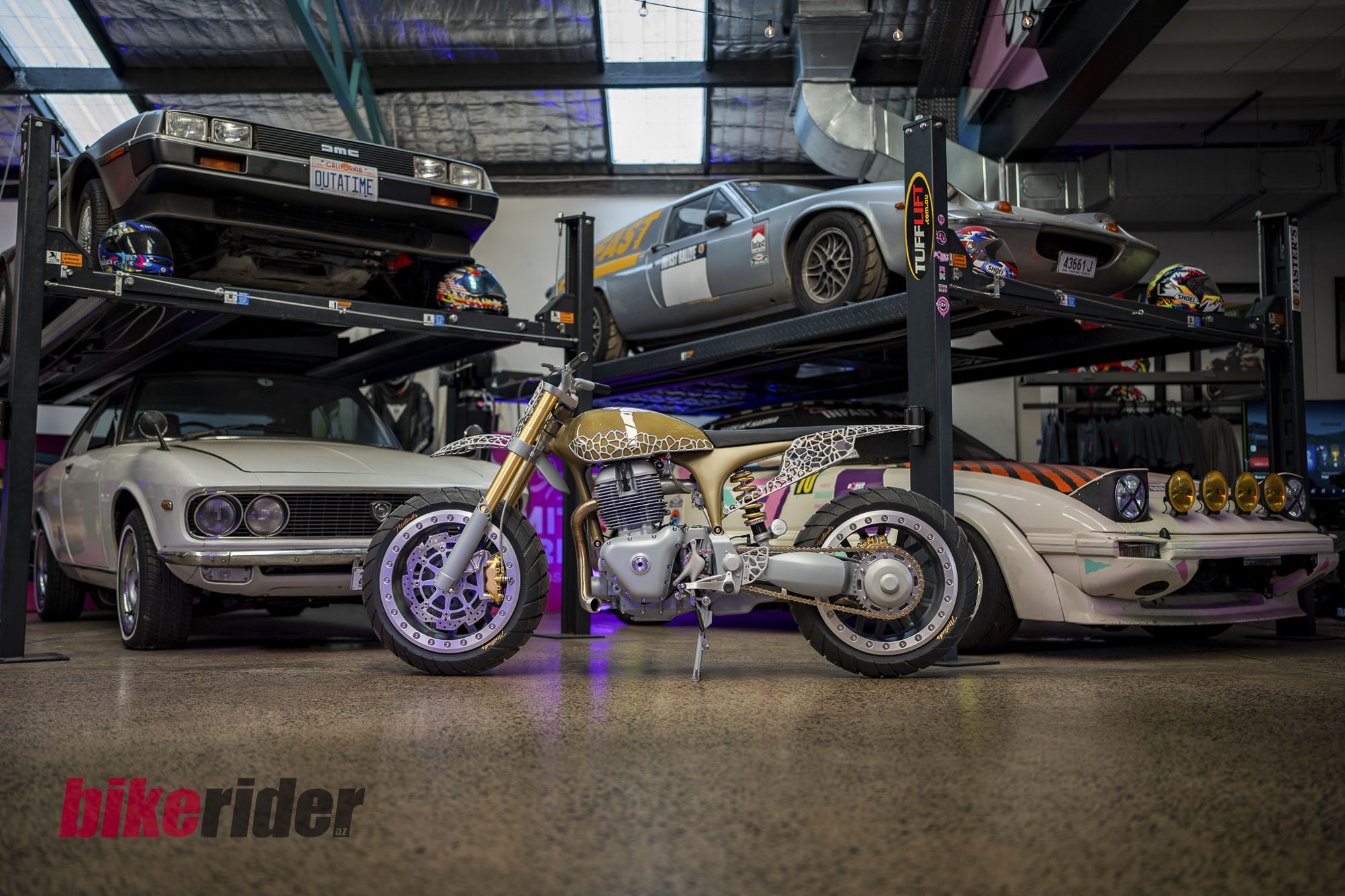
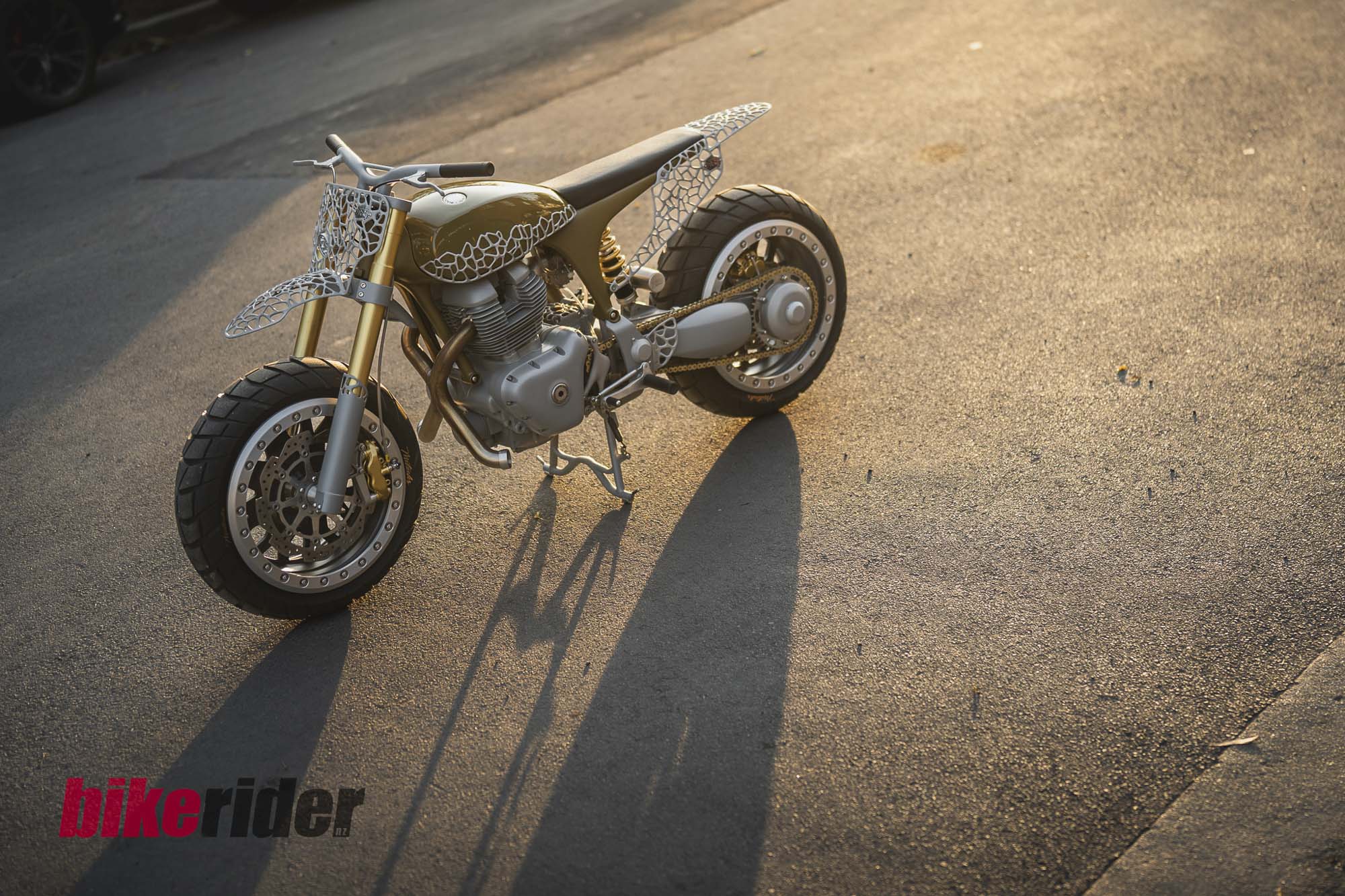
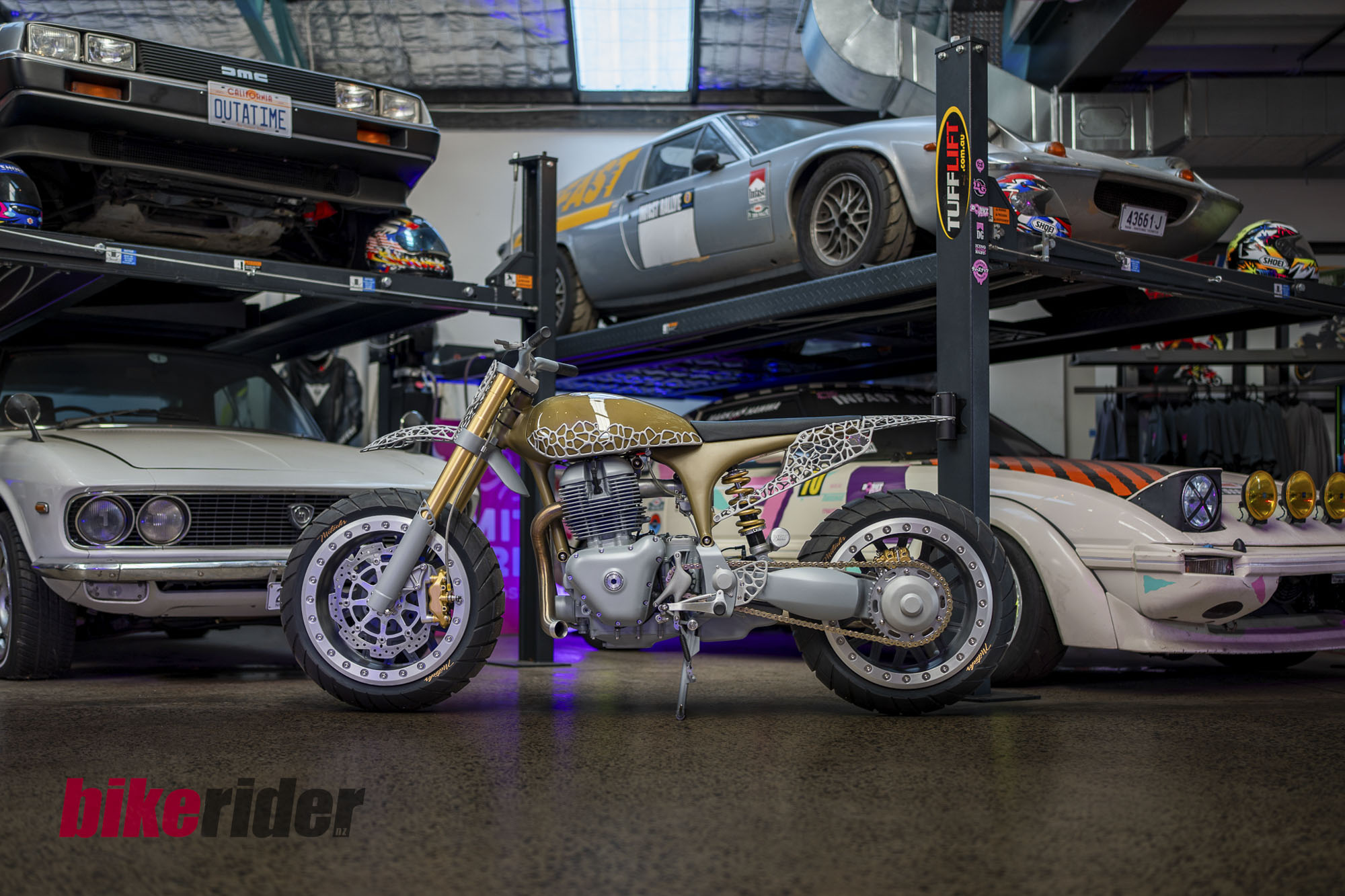
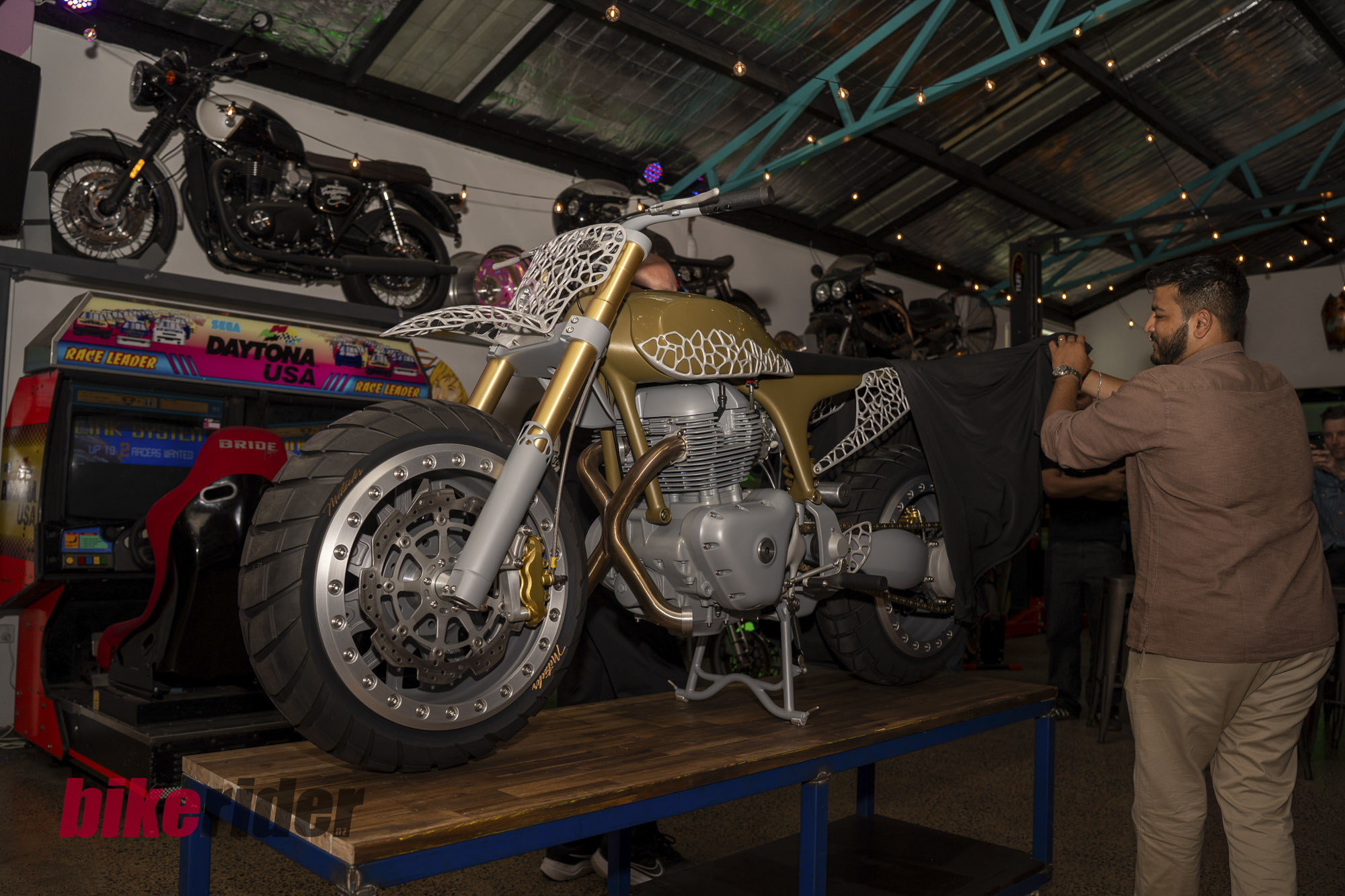
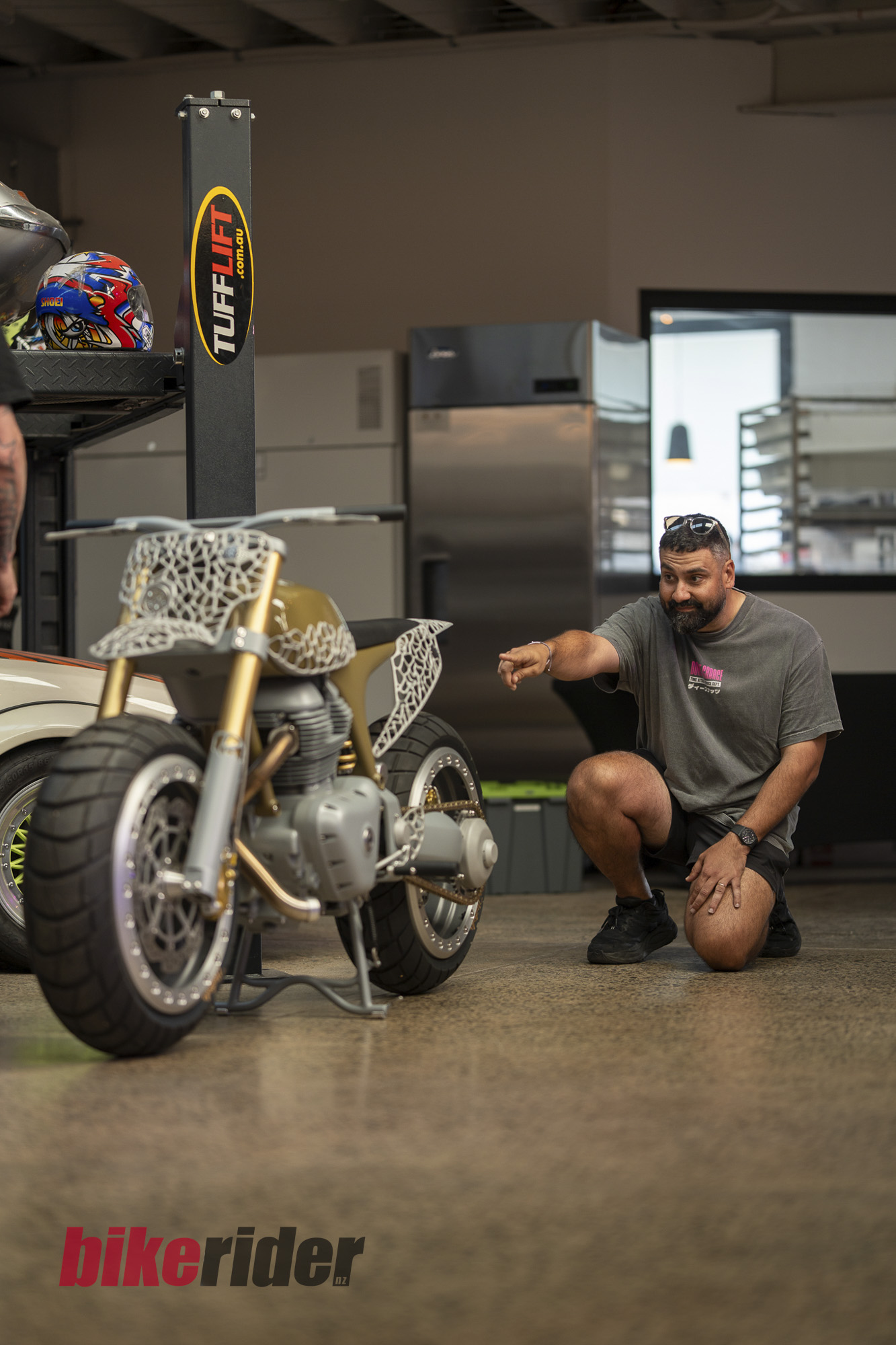
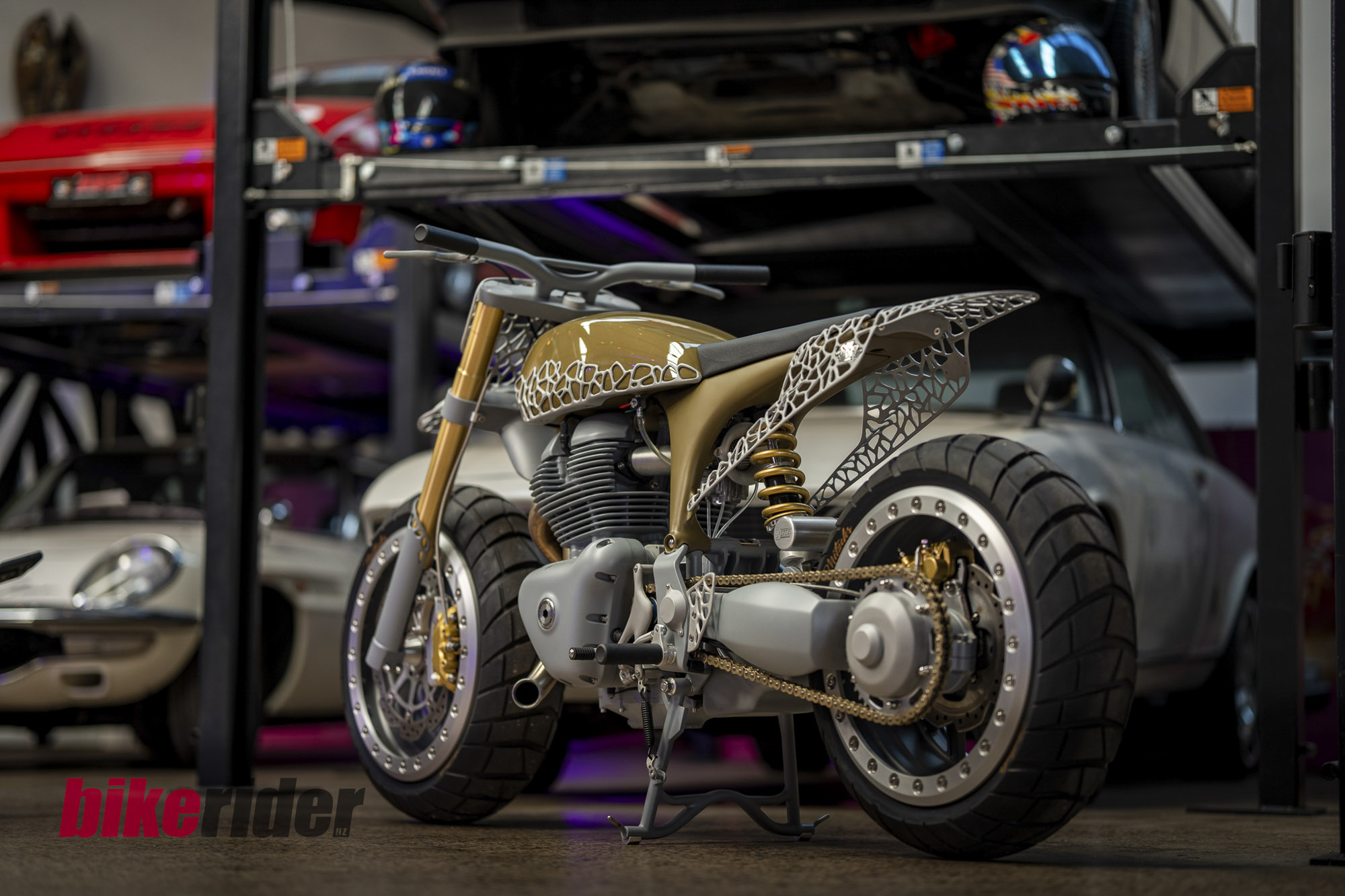
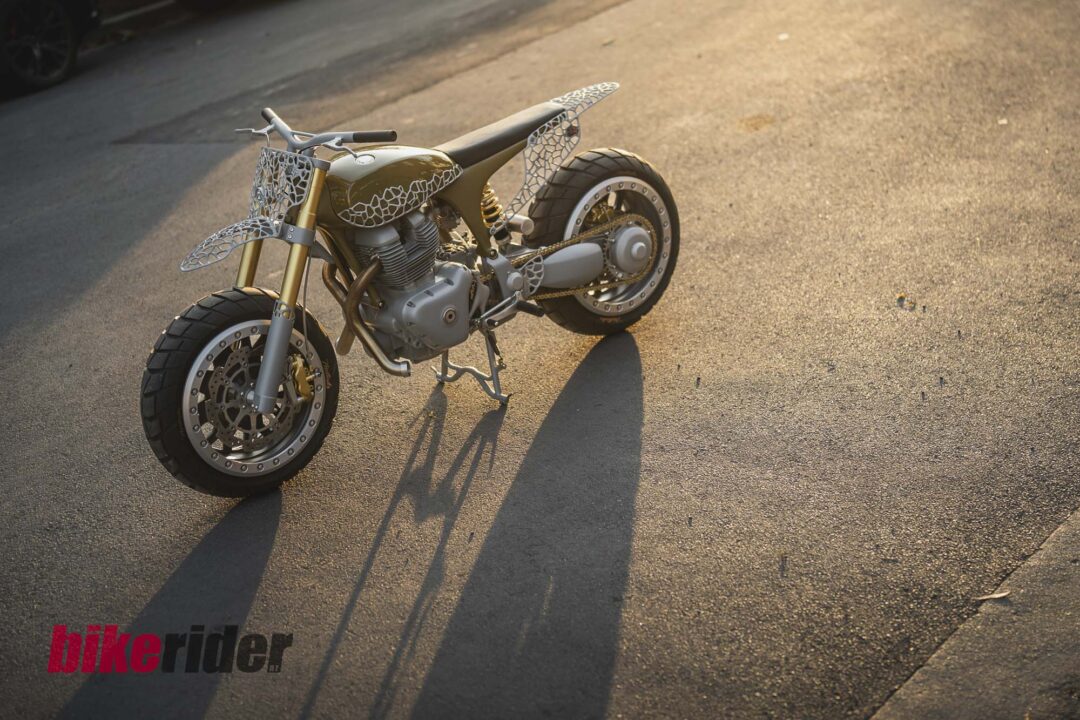
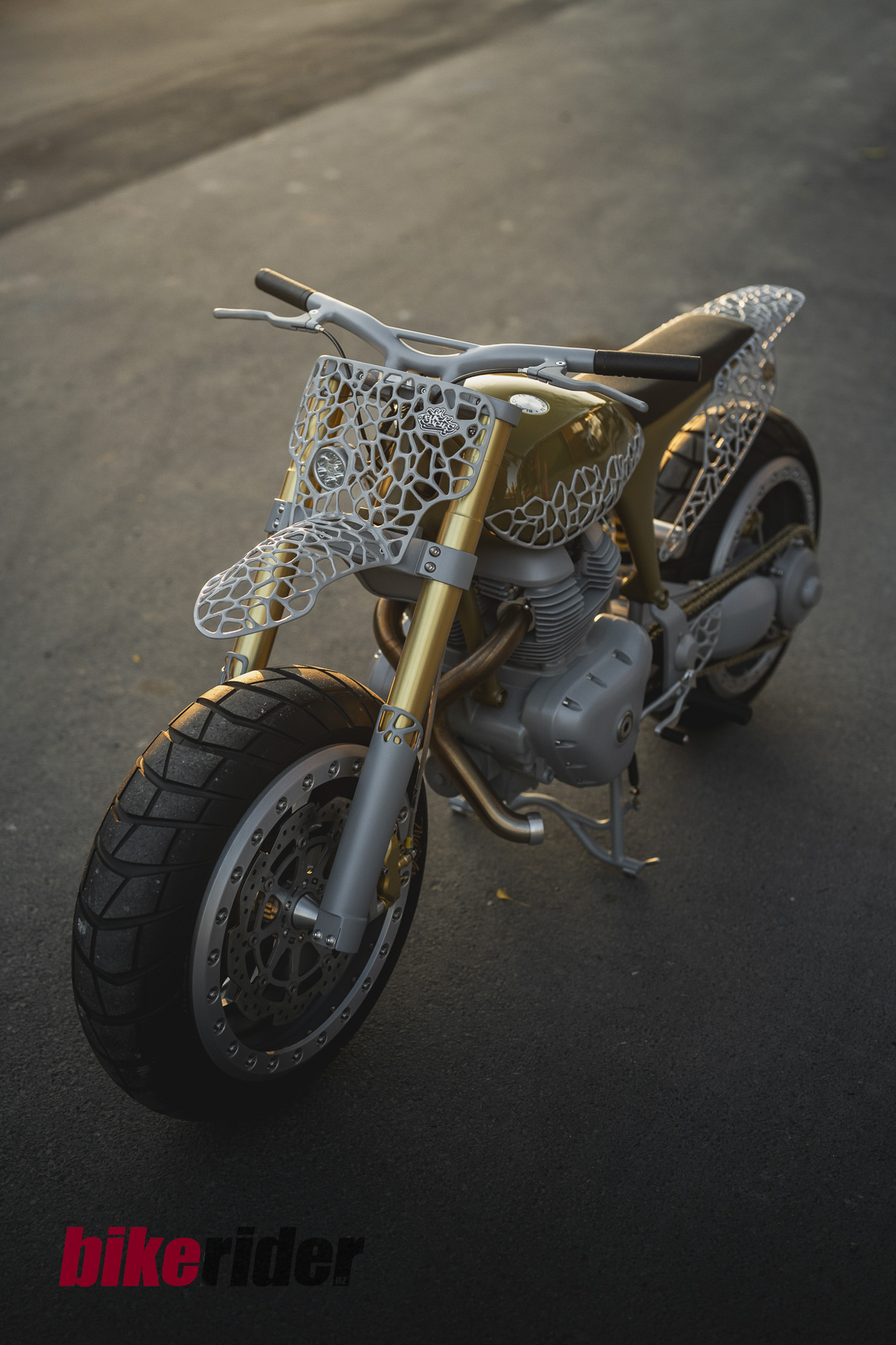
Built in collaboration with Pipeburn and Royal Enfield for the brand’s Custom World challenge, Project MEGA looks somewhere between a military prototype and something you’d find in the expensive end of an art gallery. There’s a one-off aluminium frame, a Triumph single-sided swingarm, converted 4WD wheels and bodywork that appears to have grown around the motorcycle rather than been bolted to it.
A vision before a motorcycle
The project began in early 2025 with a simple question: what would Black Cycles create if given a Bear 650 and complete freedom? Noel already had a pretty clear answer. The trouble was that the year was disappearing and the donor bike hadn’t arrived.
MORE ARTICLES
Rather than wait, he found an essentially complete but seized Interceptor 650 engine to use for the initial mock-up. It meant he could begin turning the shapes in his head into metal while the real Bear was still in transit.
“I pretty much had a complete vision for the build,” Noel explains, “and I definitely wanted a couple of features that hadn’t been seen before.”
That’s a revealing comment. This wasn’t a case of changing parts and seeing where the build ended up. Noel had the proportions, surfaces and visual weight in mind from the outset. The workshop was where he worked out how to make that vision function as a motorcycle.
“I pretty much had a complete vision for the build, and I definitely wanted a couple of features that hadn’t been seen before.”
Noel Muller
Four-wheel thinking, two-wheel application
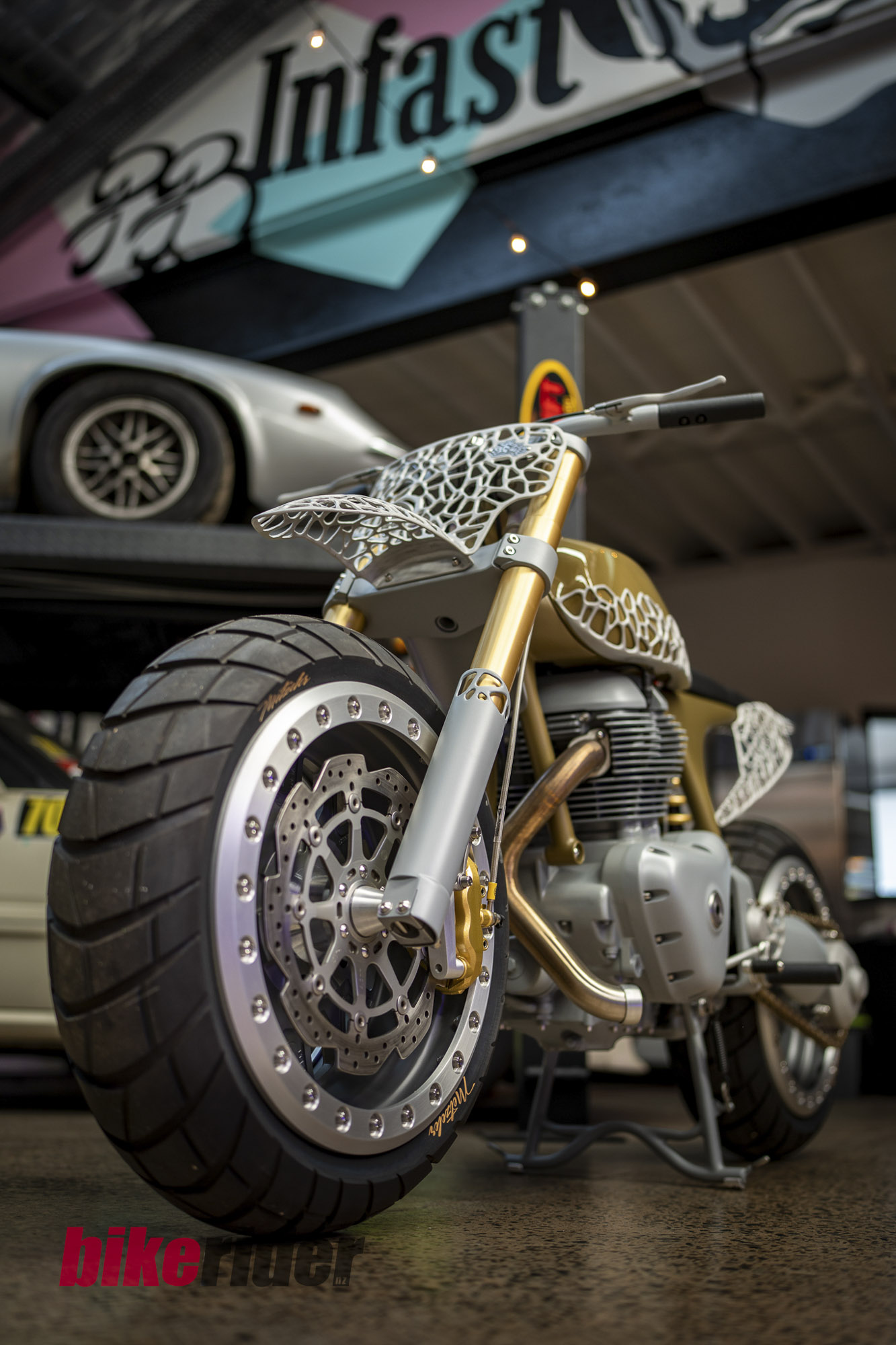
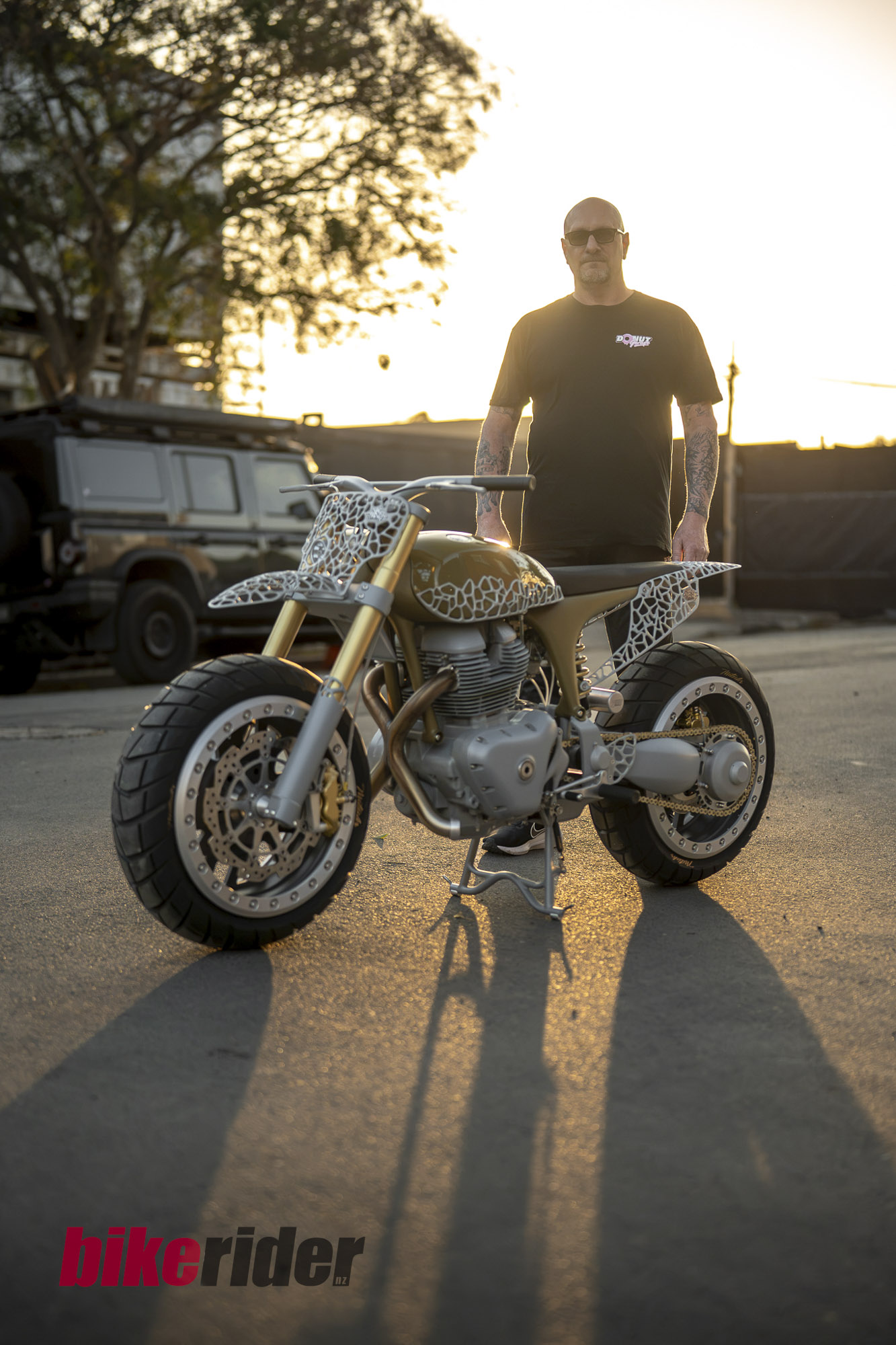
The wheels tell you plenty about his approach. Noel started with a pair of 17 x 8.5-inch hybrid beadlock 4WD rims from All Terrain Industries on the Gold Coast. They were much too wide, so he did the obvious thing — if you’re Noel Muller — and cut three inches out of each one, leaving a 5.5-inch finished width.
He machined and welded new centre sections, drilled the rear to fit a Triumph 955i single-sided swingarm and created an entirely new bolt-in front hub supported by three sealed bearings. A second beadlock ring was added to each wheel so the hardware matched on both sides. They’re probably the most immediately striking parts of Project MEGA, but also some of the most heavily engineered.
Originally Noel considered a single-sided front end to match the rear. Then he realised he’d never seen an asymmetrical 4WD wheel sitting between conventional motorcycle forks, which was reason enough to go another way. The upside-down forks sit in triple clamps widened by a whopping 60mm, with a modified 25mm axle and suspension work by XXX Rated Suspension.
Both wheels wear chunky 180/55-17 Metzeler Karoo Street tyres. They complete the military-industrial look, even if this isn’t a machine you’d necessarily take looking for muddy trails.
Building around empty space
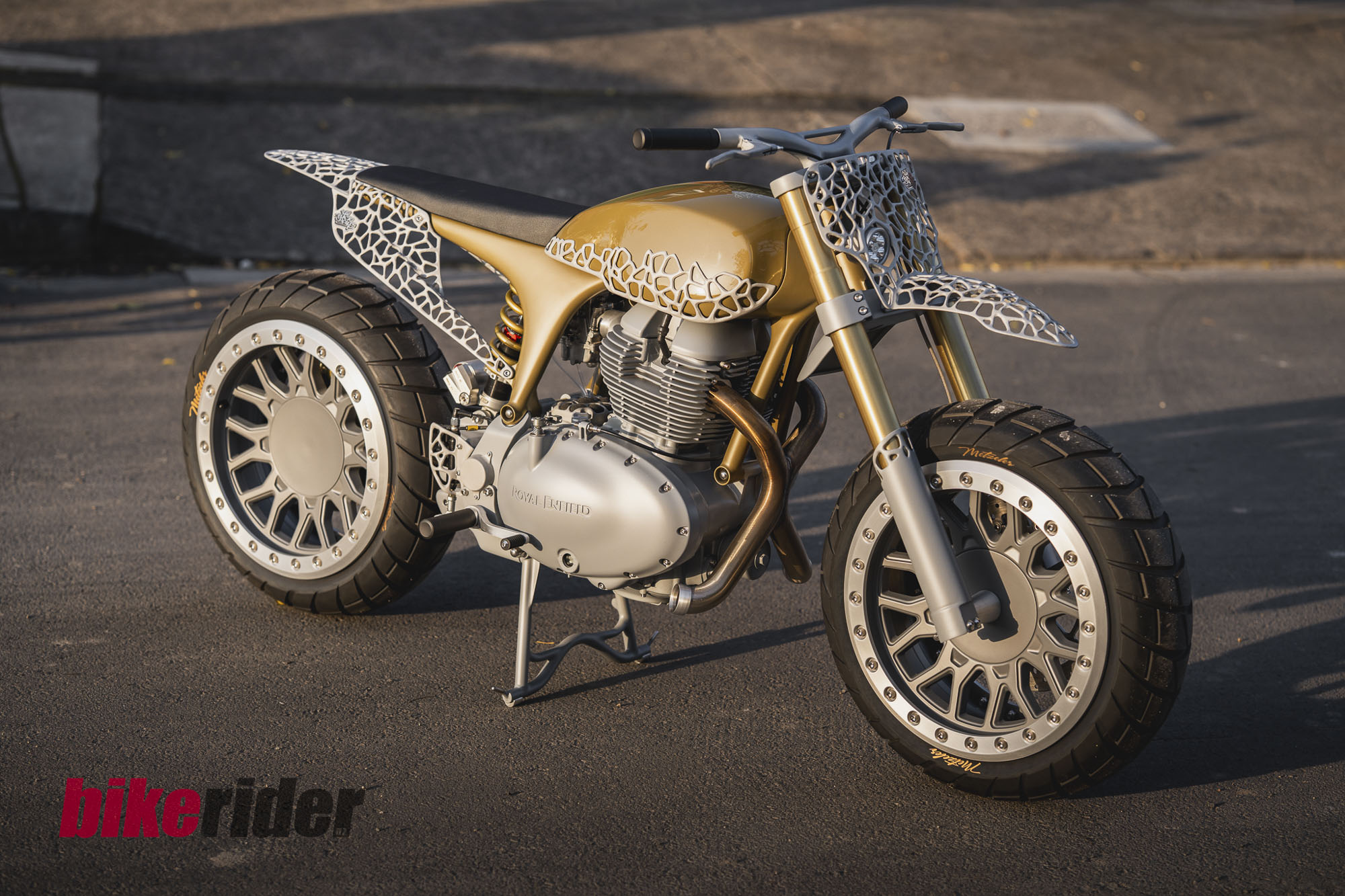
With the mock-up engine and running gear positioned, Noel fabricated a chassis predominantly from 32mm aluminium tube. Even the tubes that look straight have been passed through a roller to introduce a gentle curve. It’s a small detail, but one that takes the hard edge off the bike’s otherwise industrial form.
The engine is a stressed member, allowing Noel to dispense with a conventional lower frame cradle. That open space beneath the motor is deliberate: the gaps are as important to the look as the metal surrounding them. It’s the sort of consideration you’d expect from a sculptor, except this sculpture has to handle road loads.
The fuel tank began life on a Harley-Davidson X500, although very little of the original remains. Noel narrowed and reshaped it, removed the filler neck and built a new base. Inside, the left section holds around nine litres of fuel; the right hides much of the wiring and an ATV-style front brake master cylinder.
That concealed master cylinder helps keep the handmade aluminium handlebars exceptionally tidy. There’s an internal throttle, welded-on lever mounts and machined grips wrapped to match the seat. The right lever works the hidden master cylinder by cable, while two tiny switches beneath the left grip operate eight functions, including ignition, starter and indicators. Even the foot controls are one-offs, with smaller versions of the same upholstered grips serving as pegs.
The Triumph swingarm was stripped of its original linkage, smoothed and relieved of every unwanted hole and fitting. A fully adjustable YSS gas shock takes care of the rear suspension, while a custom battery box beneath the swingarm houses the starter solenoid, horn and regulator-rectifier. Noel even fabricated a steel centre stand that folds around it.
Stopping hardware is suitably serious: the Triumph rear brake remains, while the front uses a KTM 990 Super Duke rotor and radial caliper, adapted to the conventional fork mounting. Both discs have matching wave profiles cut into them, because apparently no detail was too small to revisit.
The Bear gets the full treatment
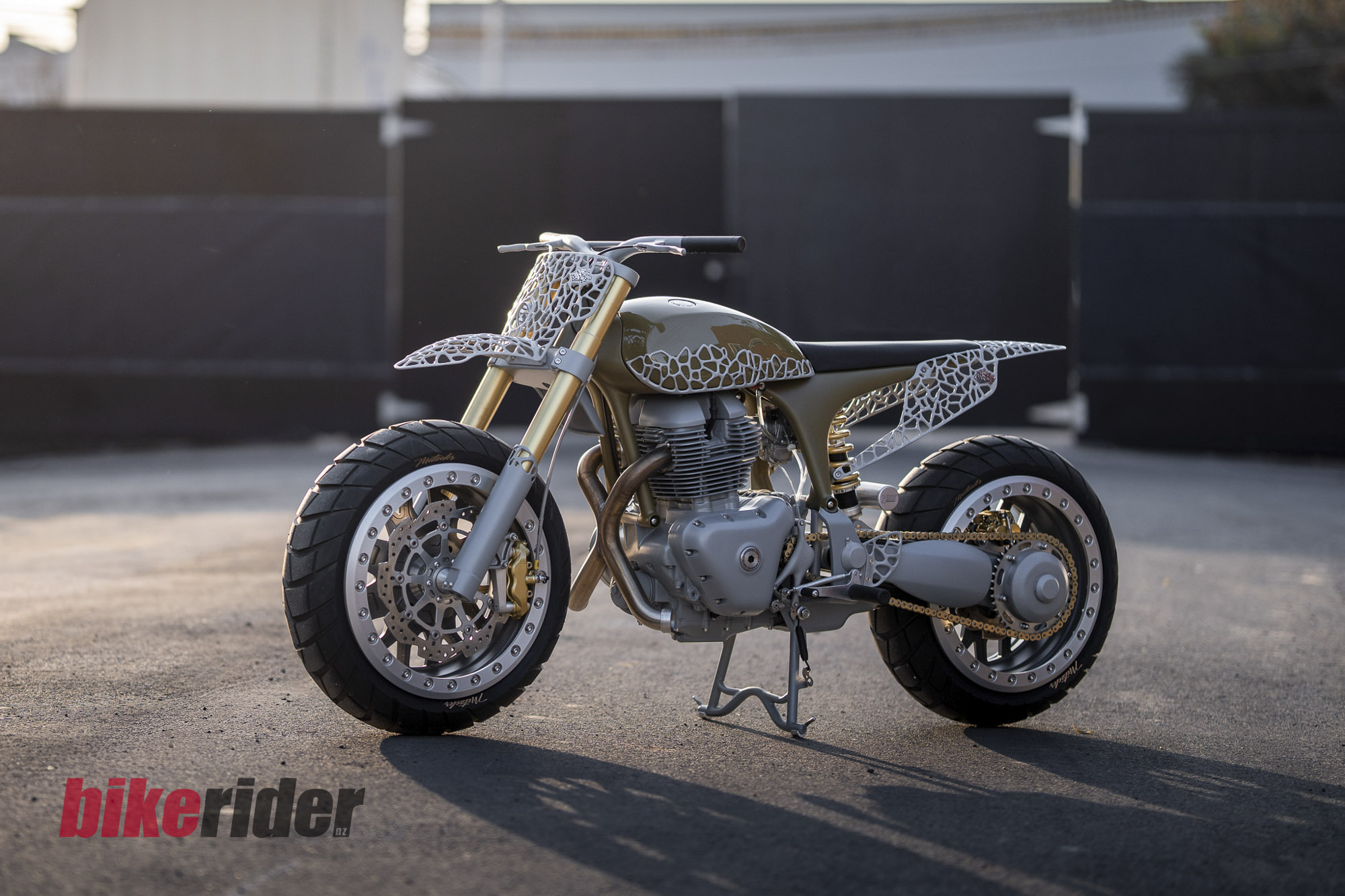
When the proper Bear 650 engine finally turned up, it wasn’t simply dropped into the frame. Noel cleaned up the casting marks, removed unwanted lumps and the redundant lower-front mount, and fitted an Interceptor right-side cover because he preferred the Royal Enfield lettering in a single line.
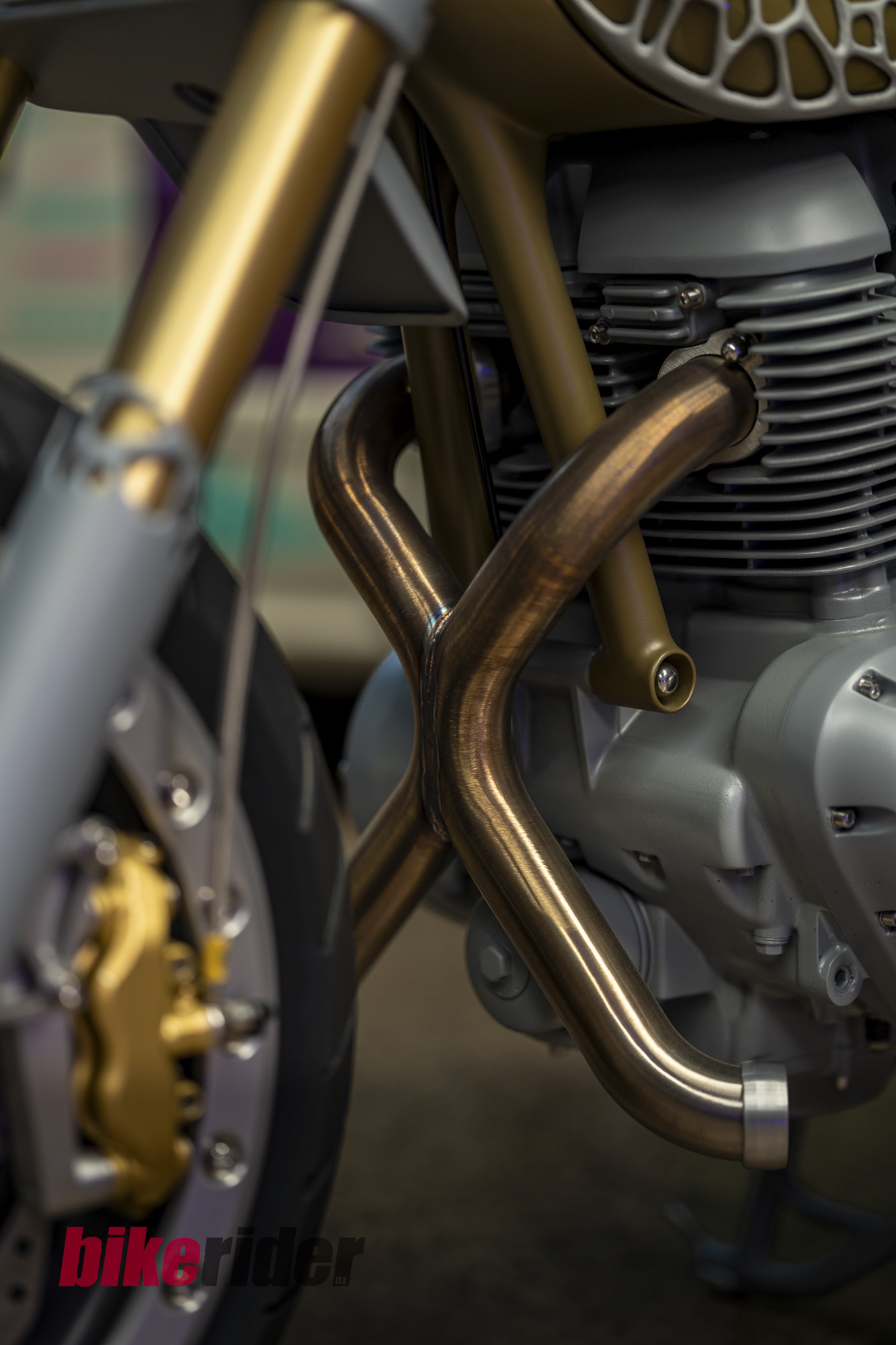
The factory fuel injection went too, replaced by a Mikuni TM40 flat-slide pumper carburettor on a custom manifold. Its beautifully machined velocity stack also supports the carburettor. Below, the handmade stainless-steel exhaust crosses into an X beneath the engine — the “X-it”, as Noel calls it — with internal baffles and machined aluminium outlets.
Getting drive out to that broad rear wheel required a specially machined 40mm-offset front sprocket with its own outboard bearing support. The wheels also received bespoke centre caps to hide their mounting hardware. From a distance, the rims look as though they were always meant to be there. Up close, the amount of work involved becomes rather more obvious.
Handmade, right down to the last bolt
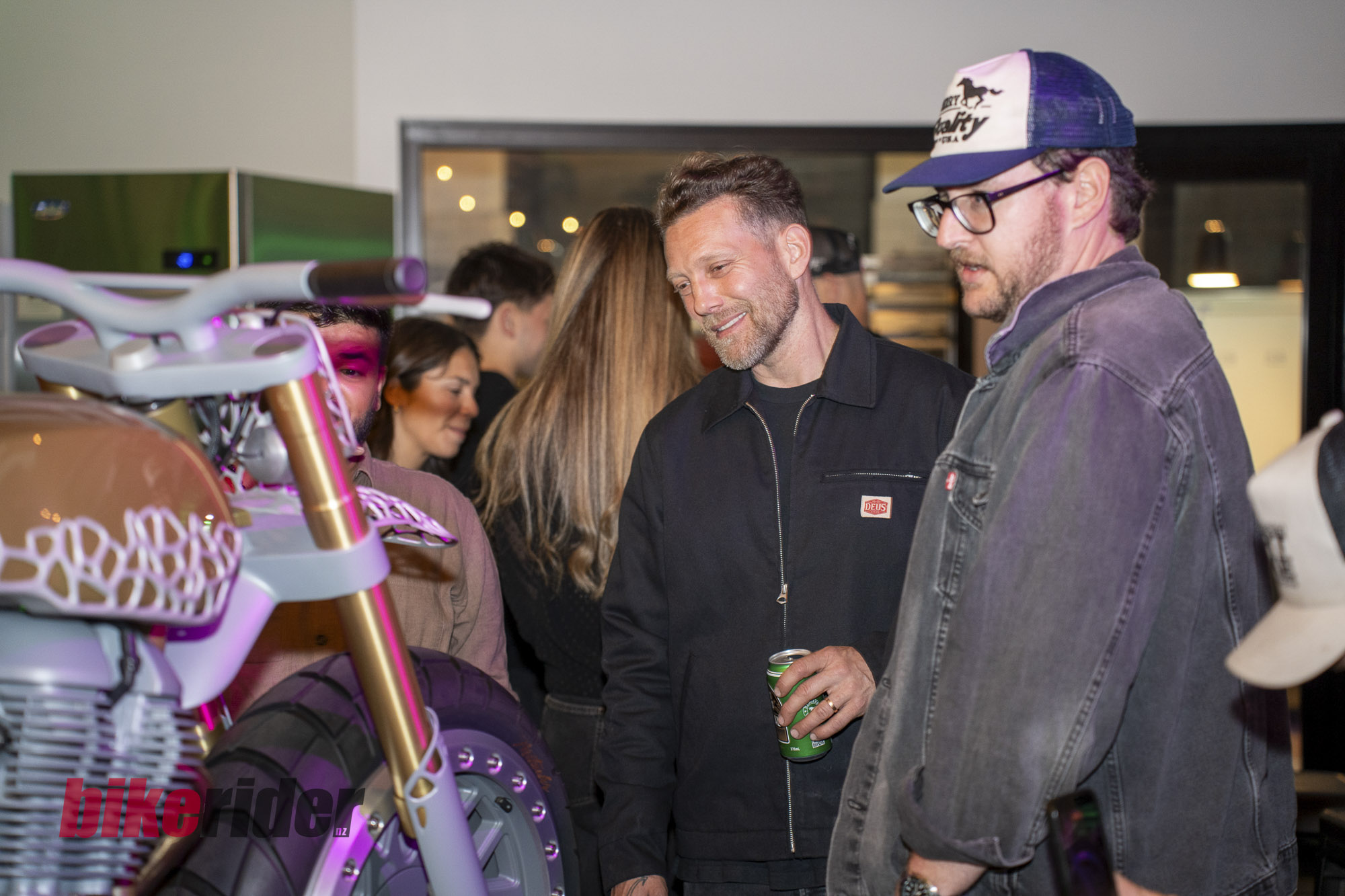
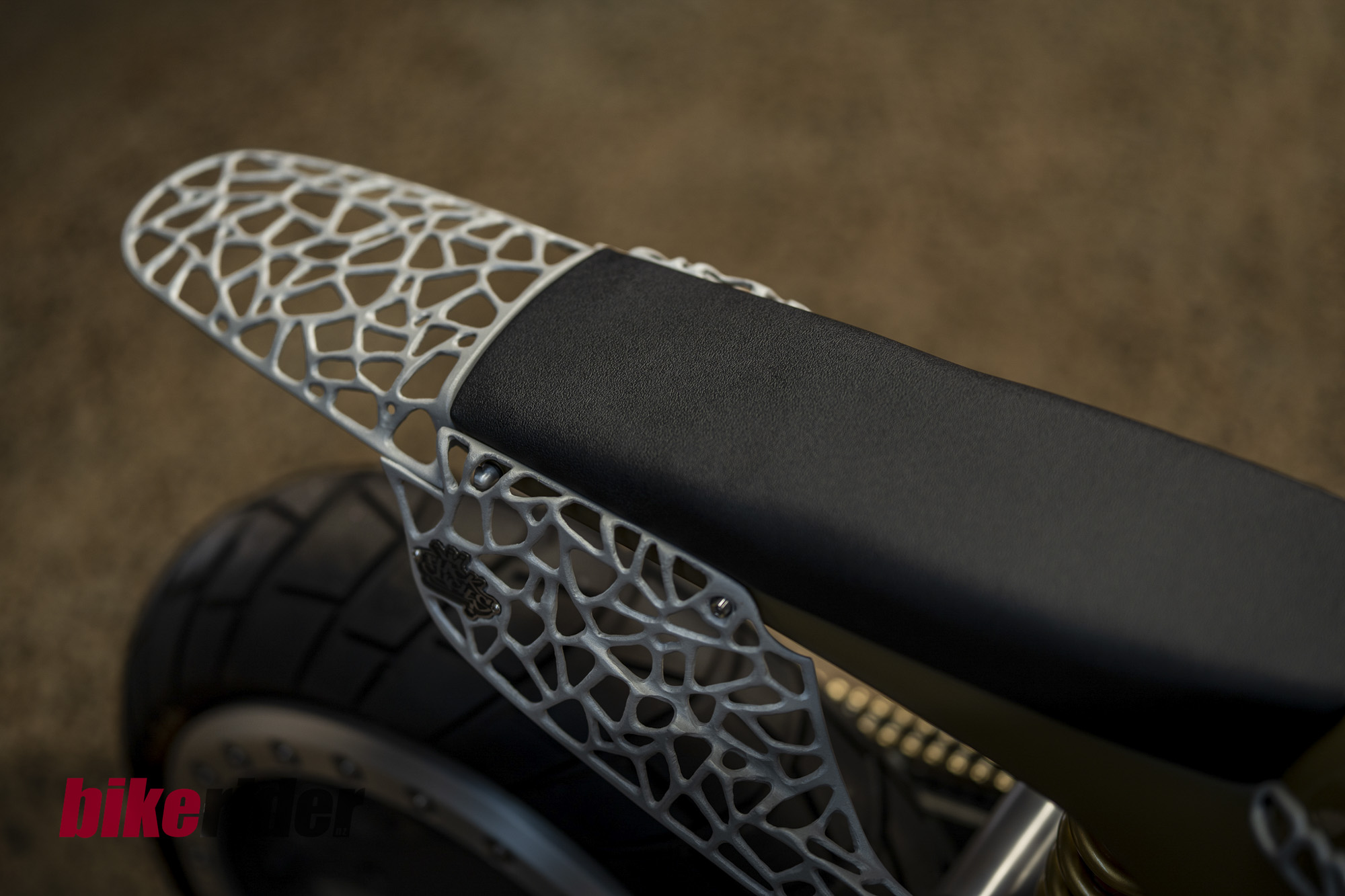
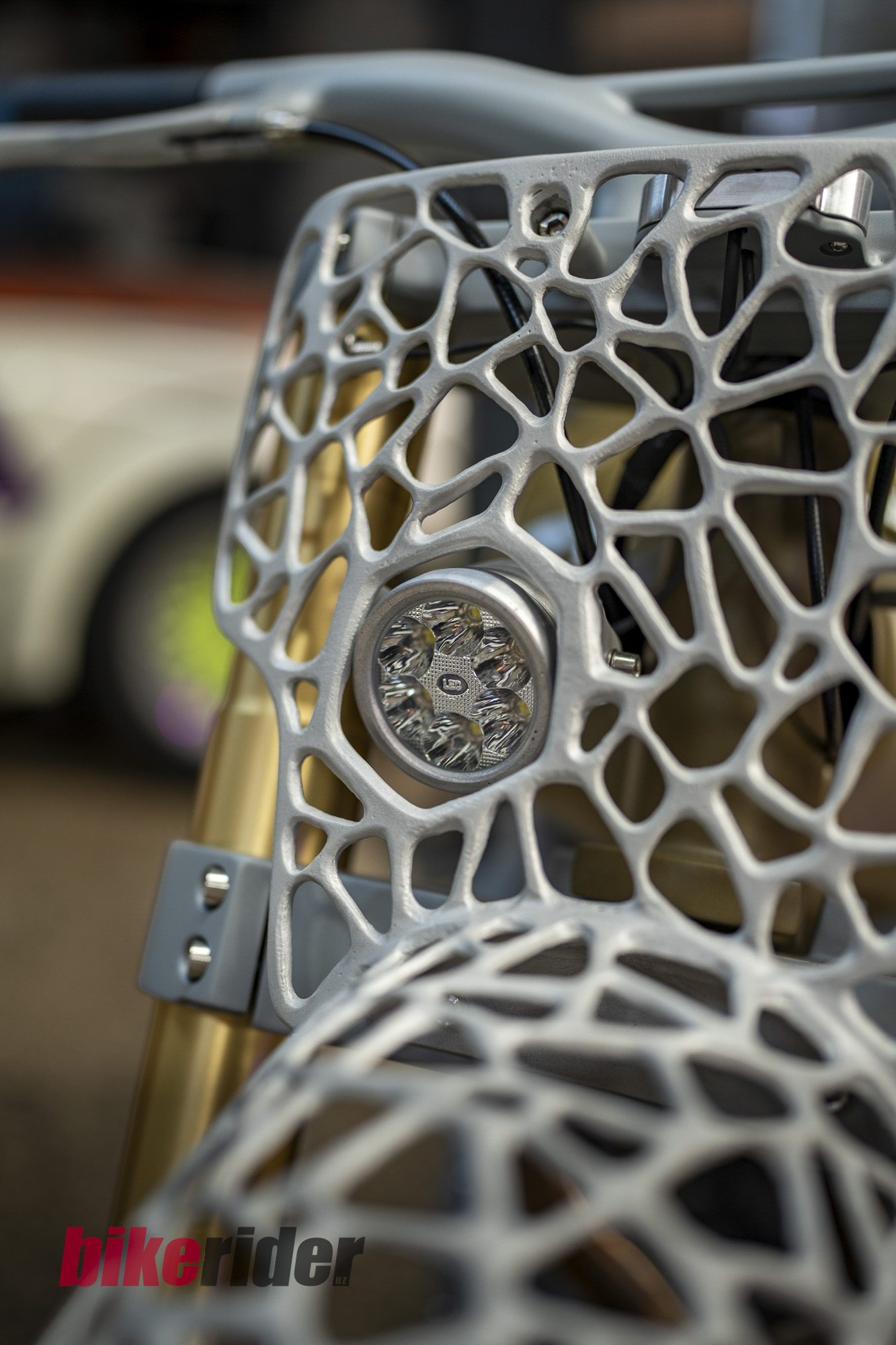
Perhaps the clearest expression of Noel’s artistic idea is in the intricate aluminium panels. They look like something an enormous 3D printer might have grown around the bike, but there was no printer involved. Every panel began as 4mm aluminium plate, with each opening marked, drilled at the corners, cut with an air hacksaw, then sanded, ground and rounded by hand.
The panels were sandblasted and finished in matt clear, and that painstaking process swallowed between 40 and 50 hours on its own. The shapes look digital and futuristic; the way they were made is about as old-school and labour-intensive as fabrication gets.
Then there are the fasteners. Nearly 200 stainless-steel Allen bolts appear across the machine, and Noel machined a seven-degree taper into every single head. Ninety-six are in the beadlock rings alone. Individually, you’d barely notice them. Together, they create a repeating pattern that ties the whole build together. That’s a fairly committed approach to the humble bolt.
Motogadget electronics include a Mini Oval speedometer, mo.lock keyless ignition and tiny combined indicators. Even the number plate is theatrical, tucked beneath the seat until an electric actuator deploys it.
The colour began with a Toyota LandCruiser gold-bronze, darkened with black into a deep olive green. The frame wears a matt finish, the tank gloss, while the engine and handmade panels use custom greys intended to resemble raw aluminium. Brushed beadlock rings and darker wheel centres complete the contrast. Justin from PBC handled the tank graphics, final clear and electrical configuration.
More than the sum of its parts
All up, Project MEGA consumed around 600 hours over five relentless months. Almost every part has been cut, widened, narrowed, machined, smoothed or built from scratch. But the achievement isn’t simply the number of hours or the length of the parts list. It’s that all those individual decisions add up to one coherent motorcycle.
Viewed as sculpture, it has texture, repetition, contrast and carefully judged open space. Viewed as a motorcycle, it has working suspension, substantial brakes, usable controls and a living, breathing Royal Enfield twin. Take away the engineering and you have an ornament. Take away the imagination and you have another modified bike. Project MEGA sits somewhere in between.
“This build has been a mental challenge for sure,” Noel admits, “but I’m stoked with the final product.”
We can see why. It probably wouldn’t be our first choice for a quick dash to the dairy, but as a demonstration of what one determined builder can do with a Royal Enfield, it’s quite something. Art normally sits quietly in a gallery. This one fires on the button and rides out the door.
A Pipeburn × Royal Enfield × Black Cycles collaboration.
“This build has been a mental challenge for sure, but I’m stoked with the final product.”
Noel Muller
Project MEGA gallery
Photography: Tom Fossati. Click an image to enlarge.