
- A race bike nobody believed in: Roland Skate spent more than 20 years developing the Honda CBX666 Beast after being told a six-cylinder Honda CBX would never make a competitive race bike.
- 130bhp of six-cylinder madness: The heavily modified 1147cc inline-six produces 130bhp at the rear wheel and helped Michael Dibb score multiple podium finishes against more conventional superbike machinery.
- Alan Cathcart is stunned: Despite its size and weight, Cathcart describes the CBX666’s handling as “frankly astonishing”, calling it one of the most improbable yet effective motorcycles he has ridden.
Alan Cathcart rides Australia’s legendary Honda CBX666 Beast, a 130bhp six-cylinder vintage superbike that spent two decades proving the doubters wrong.
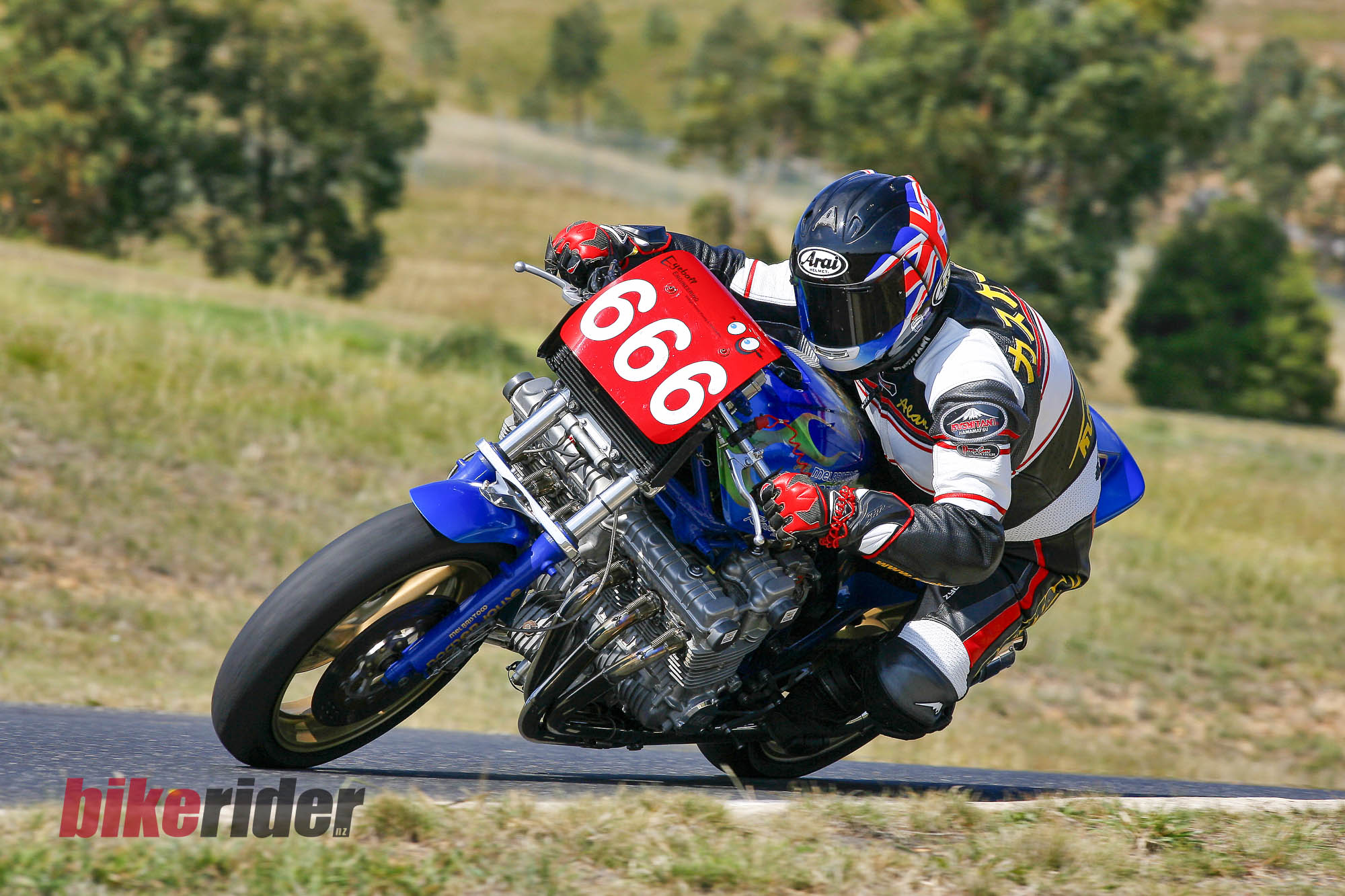
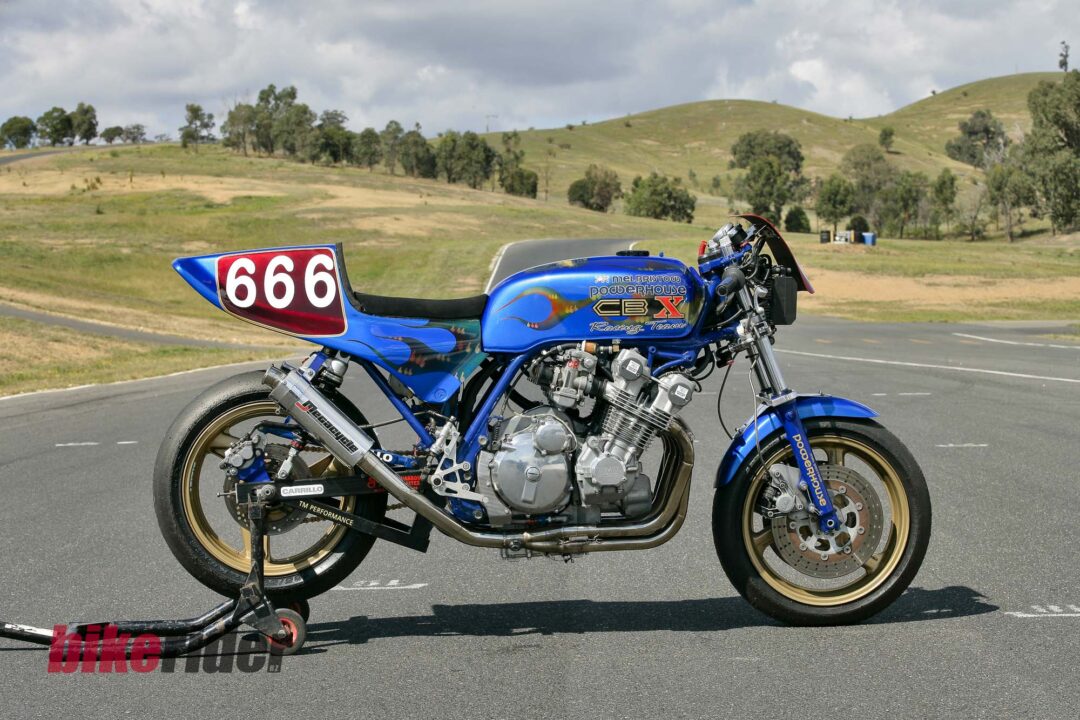
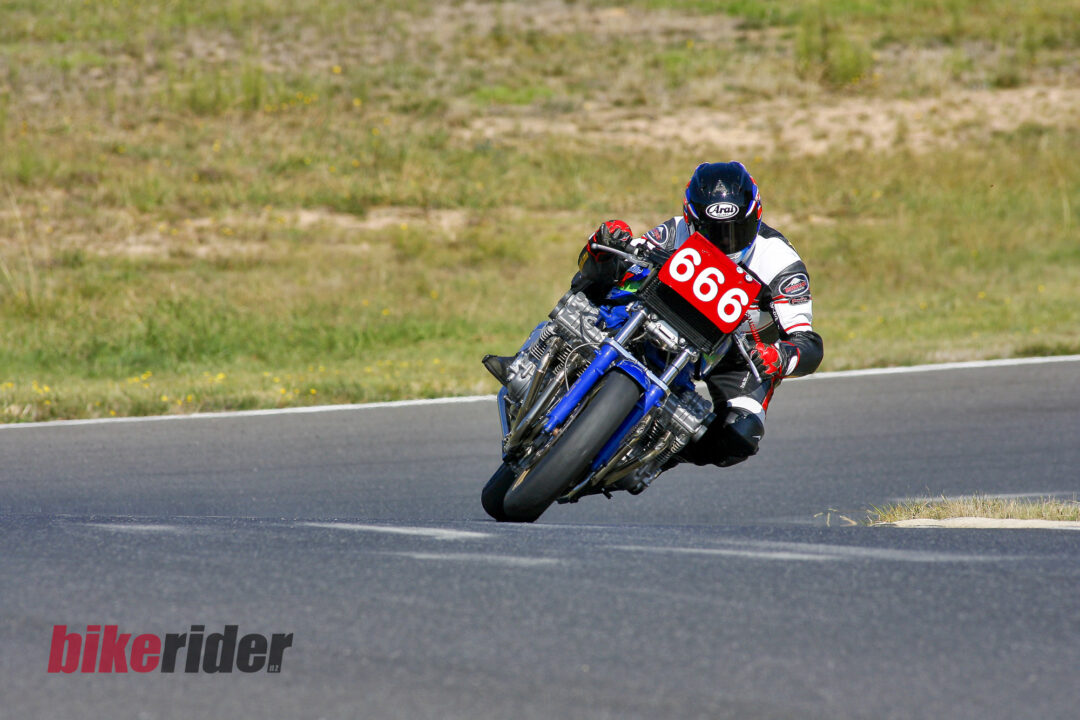
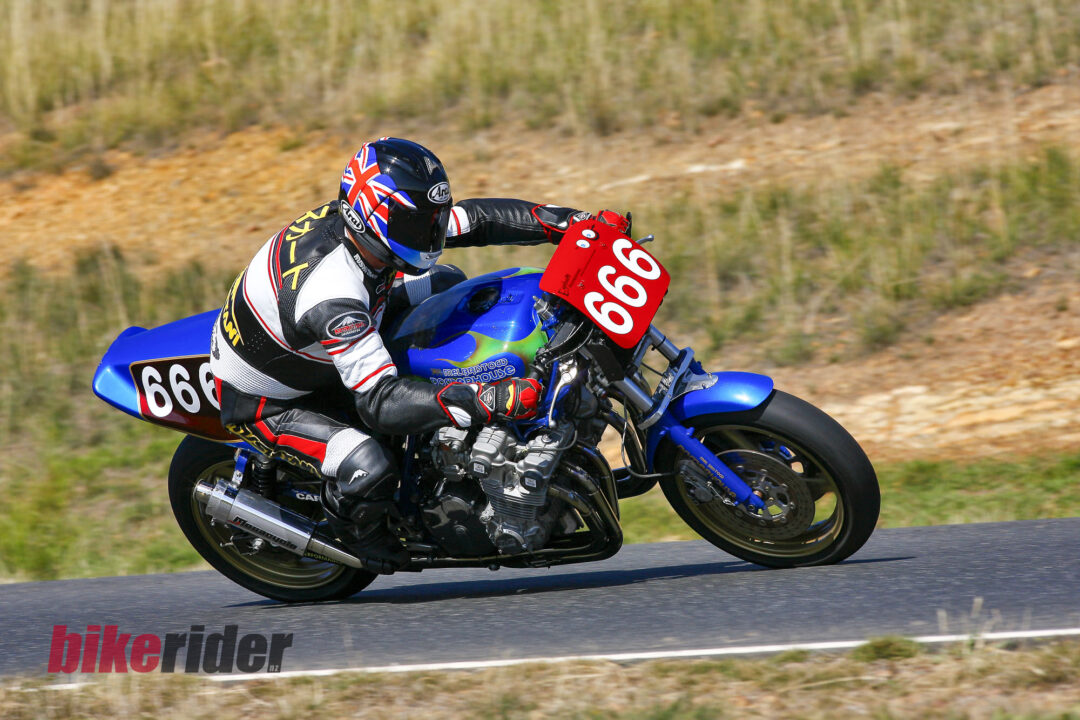
There can’t have been many devices racing anywhere in the world this century that are as improbable yet effective as Aussie Roland Skate’s butch-looking big six, his Honda CBX Superbike universally known as The Beast, and ridden by Michael Dibb to a hat-trick of third-place rostrum finishes in the Vintage Superbike support races at the 2010 Australian World Superbike round at Phillip Island.
As soon as it made its debut in the Australian MotoGP support races at Phillip Island in October 2008, the Skate six and its intrepid rider were immediate top crowd pleasers Down Under in the no-holds, fairing-rubbing, handlebar-clashing category for air-cooled multi-cylinder monsterbikes officially labelled as Post-Classic Unlimited Period 5, but best known everywhere else as Vintage Superbike.
“We just don’t have the extra power compared to the narrower fours to push the wider engine through the air down the straight,” said Roland resignedly. “But Mick rode the wheels off it in the turns, and that’s what kept us in contention. They just put the finishing line in the wrong place!”
The chance to ride Skate’s six-cylinder Superbike at the Broadford Bike Bonanza gave me a chance to confirm the improbably good-handling package it represents, on a tight 2.16km track whose many blind bends and elevation changes posed a severe test for such an apparently musclebound motorcycle that’s seemingly all engine. Especially when the 130bhp at 9,600rpm delivered to the back wheel by the tuned big-bore 1,147cc 24-valve motor is transmitted through a scrawny 4.50-inch rear wheel, the widest allowed in Post-Classic racing.
Still, at least the Motorcycling Australia rulemakers permit slick tyres to help hook up the horsepower, in recognition of the 1300cc top limit for Historic racing’s big-bike category which encourages tuners to go large on engine upgrades, thus adding to the show while also removing concerns about having to measure the overbored one-litre-plus engines proliferating in the class.
MORE ARTICLES
Twenty Years In The Making
A self-employed carpenter from the scenic Yarra Valley east of Melbourne, Roland Skate has been stuck on sixes since 1982. That’s when he bought his first CBX – a well-used ex-drag racer that he rode and rode until it turned into a ratbike.
“I just fell in love with it because it gave so much performance, and especially so much fun, in return for so little attention,” says Roland with a wry smile. “I began doing track days and eventually plucked up the courage to go racing with it – so that’s when I thought I better give it a bit of TLC! After that first race at Mount Gambier in 1994, I’ve been progressively modifying it on and off ever since.”
Even so, a five-year layoff after dropping a valve in practice at the 2003 Island Classic, which saw the CBX sidelined with holed crankcases, might have become permanent if not for meeting impecunious but gifted novice racer Michael Dibb in 2007, a fellow Hartwell Club member.
Determined to help him show his worth, Skate decided to rebuild the CBX as a Post-Classic Period 5 Superbike for Dibb to ride.
“People used to rubbish the CBX all the time when I used to race it, saying it’d never ever make a racebike,” says Rol. “But I knew the bike had it in it to be successful if I got a good rider aboard it – and I reckoned Mick had the potential.”
Skate had previously promised to help Mal Bristow, a fellow member of the Australian CBX Owners Club out in Perth, build a CBX racer, and had been sending him parts for the project – only for Bristow sadly to pass away before it had even got started.
“A pair of shakedown club races with a lightly tuned motor taught Dibb how to ride a bike not like the others, but ground-clearance problems with the stock frame and slick tyres remained an issue.”
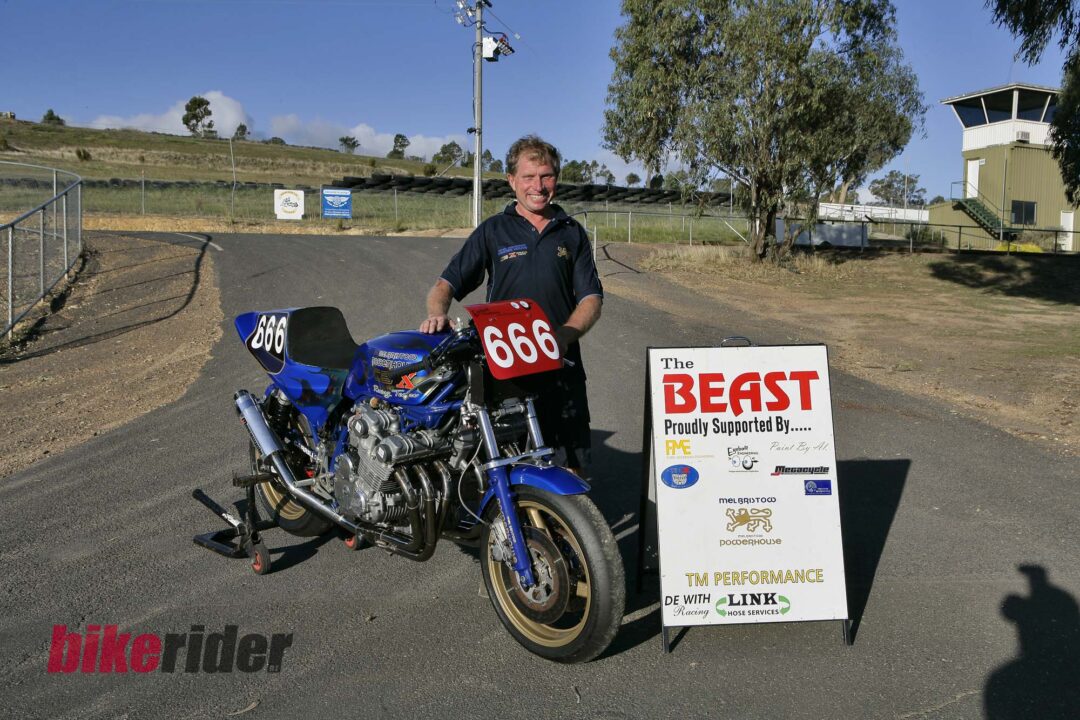
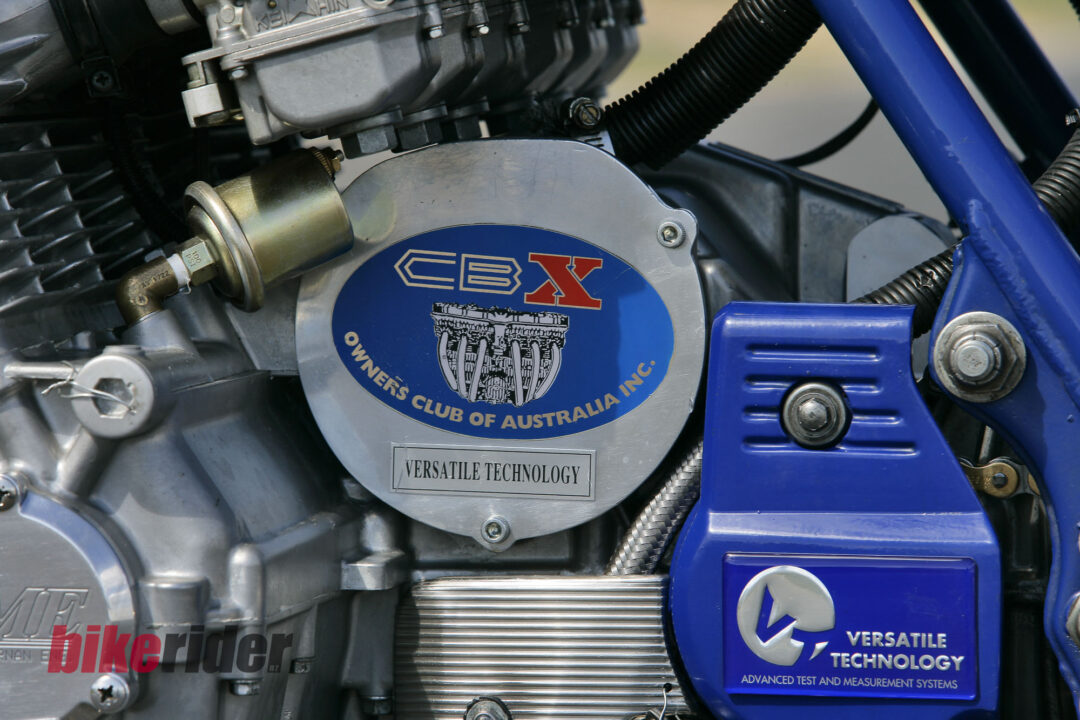
“Mal’s widow Val insisted on sending me everything he’d collected, and asked me to build a bike in his memory, because it’s what Mal had wanted to do himself,” says Roland. “That’s why his name’s on the bike today, together with their family’s freight forwarding firm, PowerHouse Clearances – The Beast wouldn’t exist if not for them. Between Mal’s collection of parts and my blown-up bike, we had enough to build one good racebike and a spare engine.”
A pair of shakedown club races with a lightly tuned motor taught Dibb how to ride a bike not like the others, but ground-clearance problems with the stock frame and slick tyres remained an issue.
Help arrived in the shape of American CBX guru Tom Marquardt, who brought his US-spec Superbike six over for the 2008 Island Classic and ended up crashing it. After spending several weeks recuperating as a guest of the Skate family, Marquardt insisted on taking Roland’s stock CBX frame home and modifying it to the same specification as his own long-running endurance racer.
PowerHouse shipped it back to Australia, and Roland then had Ted Bishop in Melbourne create a further evolved version before work began on building the definitive CBX Superbike.
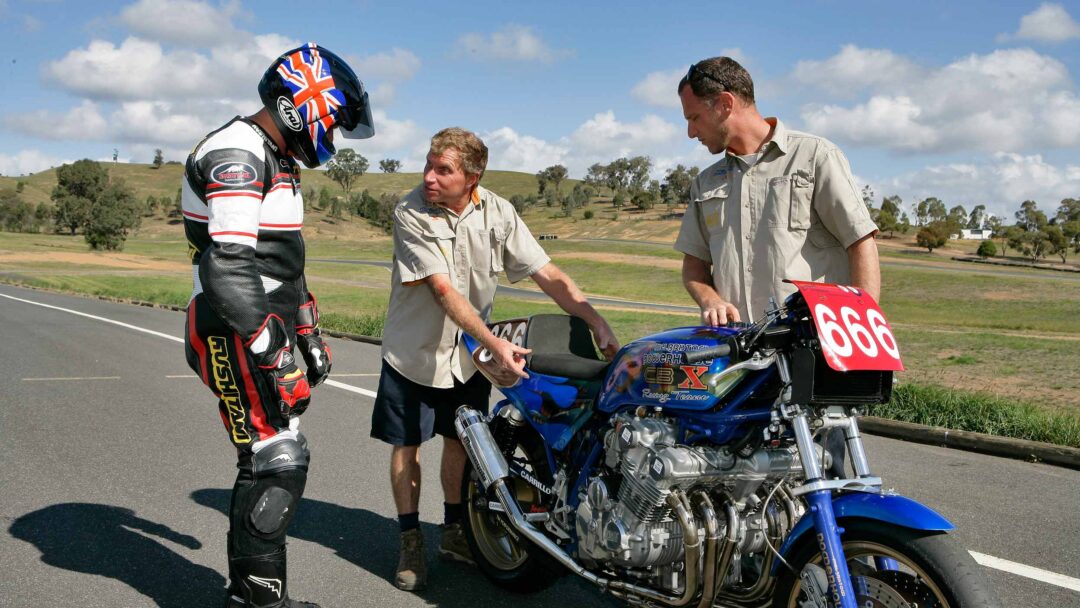
A Debut Straight Out Of A Movie Script
The Beast’s debut in the trio of Vintage Superbike support races at the Australian MotoGP in October 2008 came straight out of a movie script.
“We finished the bike at 5am on the morning of qualifying,” recalls Roland. “It had zero miles under its wheels apart from a quick run up and down the road to make sure it changed gear OK, and Mick had never ridden it before in that configuration.
“We went straight from the workshop to the track, and he qualified the CBX in fifth place on a 40-bike grid with all the stars like Rob Phillis and Malcolm Campbell there, as well as the Irving Vincent…”
“We went straight from the workshop to the track, and he qualified the CBX in fifth place on a 40-bike grid with all the stars like Rob Phillis and Malcolm Campbell there, as well as the Irving Vincent – it was just amazing! It was an instant crowd-pleaser – we had to fence off the bike to have room to work on it.”
When Dibb finished fifth in the first race despite having no fourth gear, it was the icing on the cake.
From that moment on, the six-cylinder Honda became one of the star attractions of Australian Post-Classic racing, eventually earning those three podium finishes at Phillip Island and narrowly missing the Australian Historic title by just two-hundredths of a second.
Building The Beast
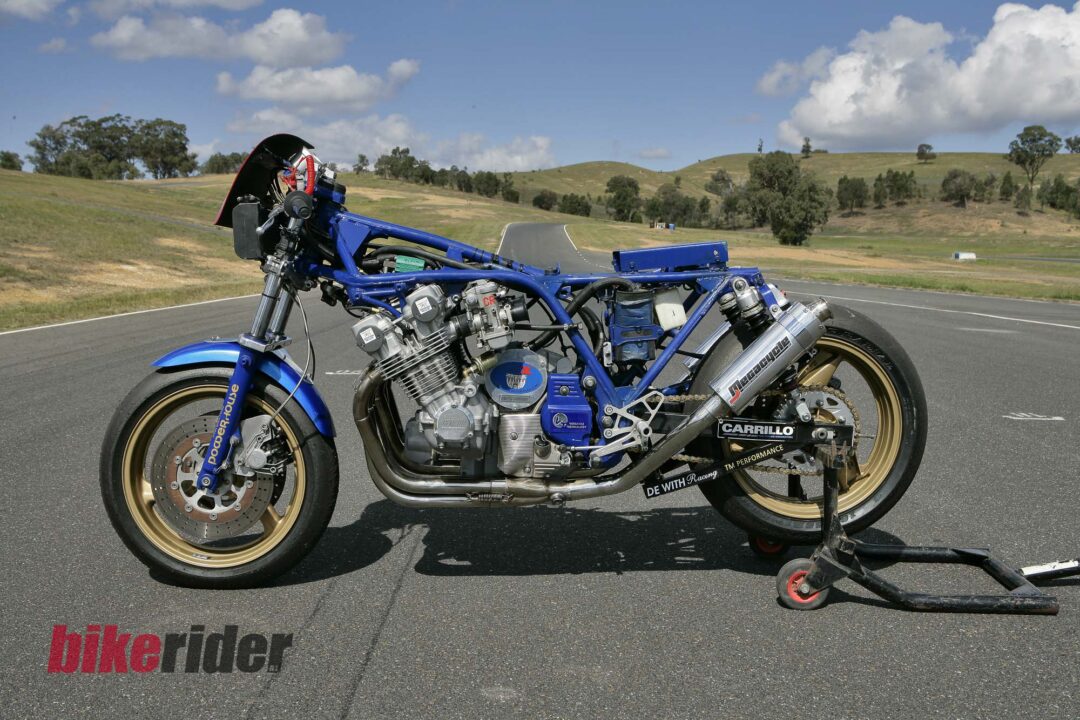
To create the Stage Three version of the bike I rode at Broadford, Roland Skate took a stock CBX engine weighing 102kg complete with carburettors, removed the generator and starter motor assembly, and extensively reworked the internals.
The result is a 1,147cc six-cylinder engine producing 130bhp at the rear wheel and 97.6Nm of torque.
“We’ve tried heaps of different American race cams, some with very high lift, but these Web-Cams are the best,” says Roland.
“They’re not as aggressive as some we’ve used. We used street cams for quite a while because they made the bike more rideable, but these are the best compromise. They’re still pretty tractable and give us 130bhp at the rear wheel with quite a nice spread of power.”
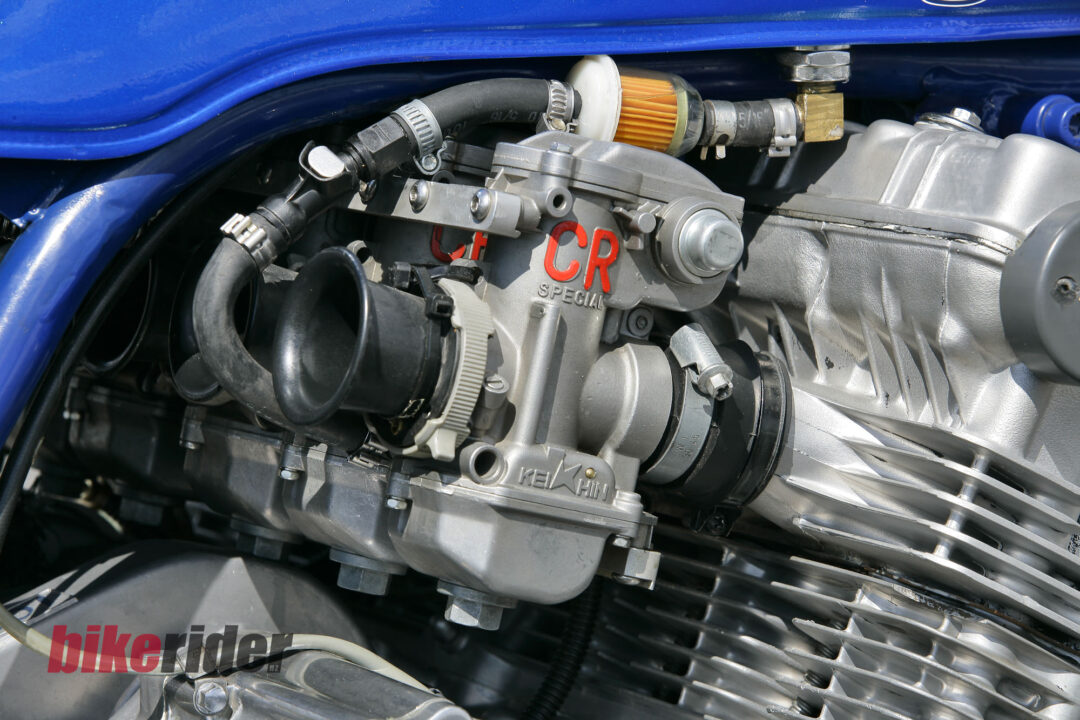
Six 31mm Keihin CR-S smoothbore carburettors replace the stock units, feeding the engine through a fuel pump and delivering the mixture required by the heavily modified six.
The bike retains its original five-speed gearbox, backed by a Barnett heavy-duty Kevlar clutch.
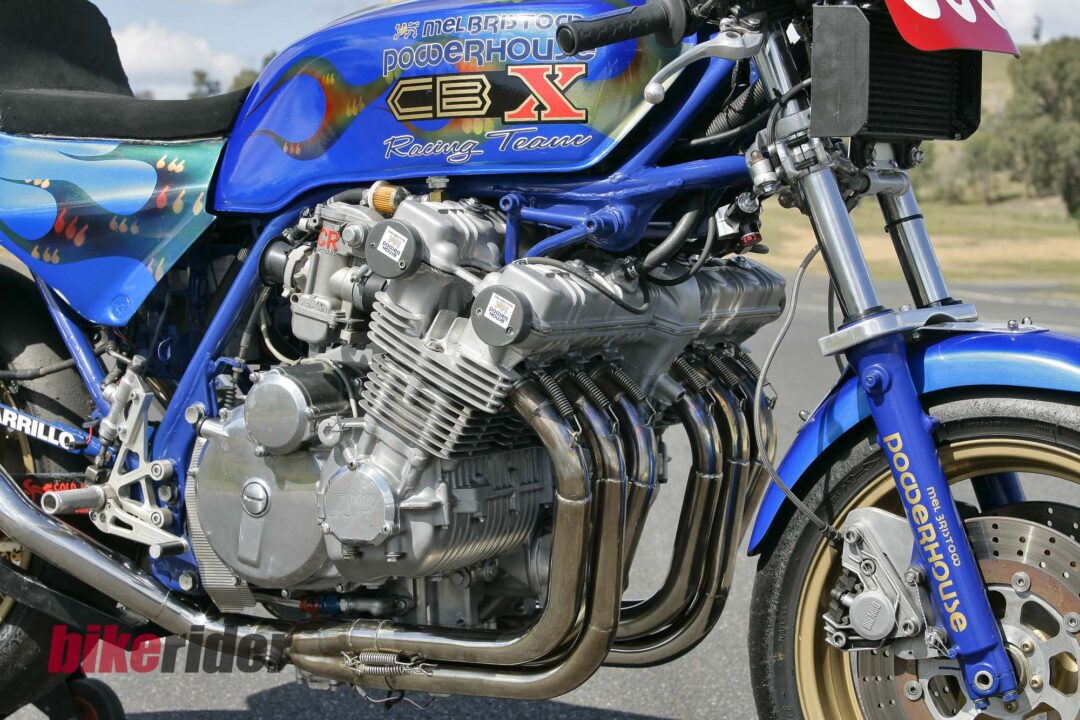
As I rode it at Broadford, The Beast weighed 227kg ready to roll, complete with oil and ten litres of Avgas in the stock steel fuel tank. The tank artwork, created by Alan Bailey, depicts a CBX engine with a devilish beast emerging from it, complemented by the subtle 666 race numbers worked into the flame graphics.
Very satanic.
Why The Beast Works
A key ingredient in The Beast’s success has been the revised geometry of the Marquardt/Bishop frame.
The stock CBX chassis was modified to position the engine higher and further forward in the frame, increasing ground clearance and improving front-end loading. Rear ride height was increased, while the steering geometry was sharpened considerably compared with the standard CBX.
“However, this still didn’t give enough ground clearance, as Mick was grinding out the crank end caps even with Tom’s frame,” says Roland. “So we had Ted Bishop roll the engine back further on his copy, lifting it at the front by 15mm to give us more room. Now he doesn’t ground the bike out anywhere.”
On paper, it all sounded promising.
The question was whether it would work on the track.
Riding The Beast
It took the best part of a day to get even a hint of the answer, after The Beast declined to run on all six cylinders when fired up for our late-morning outing at Broadford.
Turned out the freshly painted fuel tank still had swarf in it, so that meant extracting all six carburettors, stripping them and cleaning them out.
One downside of having 50 per cent more cylinders than anyone else.
Fortunately, by the following day everything was working properly.
Except that riding The Beast at fast touring pace had done nothing to prepare me for riding it in anger.
This is a bike of many colours, as well as a paradoxical package in terms of performance.
“I’ll admit I worked up gradually to cranking it over harder and harder, because even though Michael Dibb assured me it no longer decked the engine on the tarmac, I still needed convincing.”
Imposing but not encumbering, the CBX has heaps of presence when you first see it, a visual impression of a gorilla of a motorcycle which surprisingly isn’t borne out when you ride it.
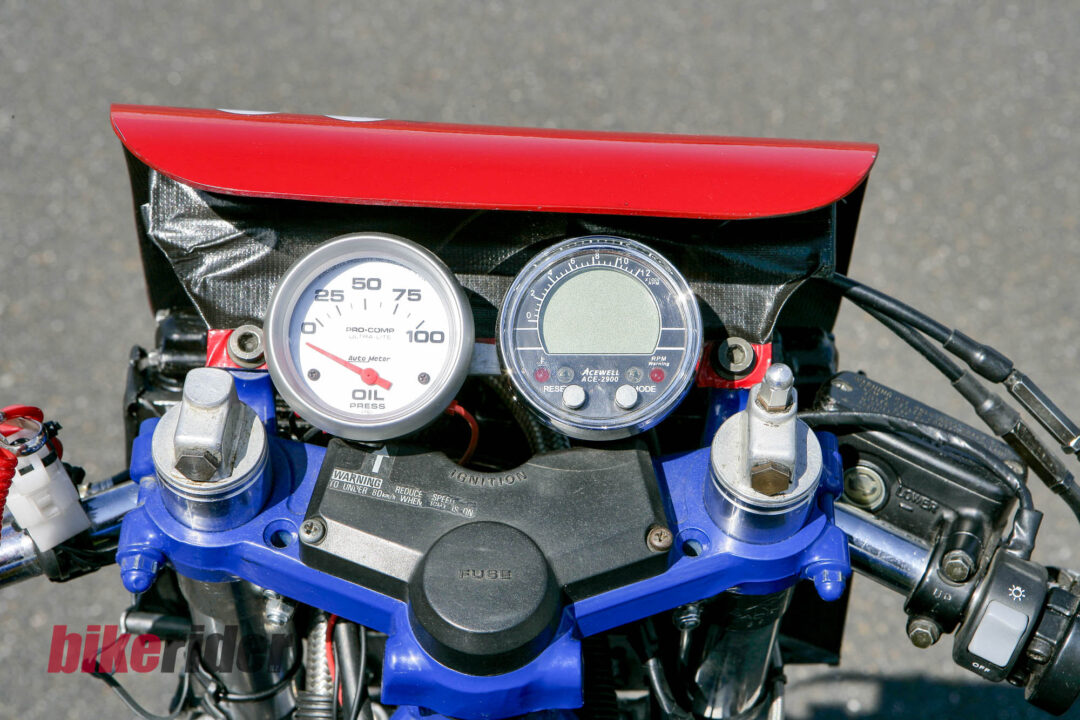
You need to tiptoe aboard thanks to the tall rear ride height needed to deliver crucial extra millimetres of ground clearance, while the high seat pushes your weight forward onto the wide-spread Tingate clip-ons.
These are set very flat, a key element in providing the leverage needed to hustle what is undeniably a physical motorcycle from side to side through corners.
I’ll admit I worked up gradually to cranking it over harder and harder, because even though Michael Dibb assured me it no longer decked the engine on the tarmac, I still needed convincing.
Working up to a respectable pace taught me that, within the limits of the skinny Dunlop slicks, the CBX now has plenty of ground clearance and surprisingly good front-end grip.
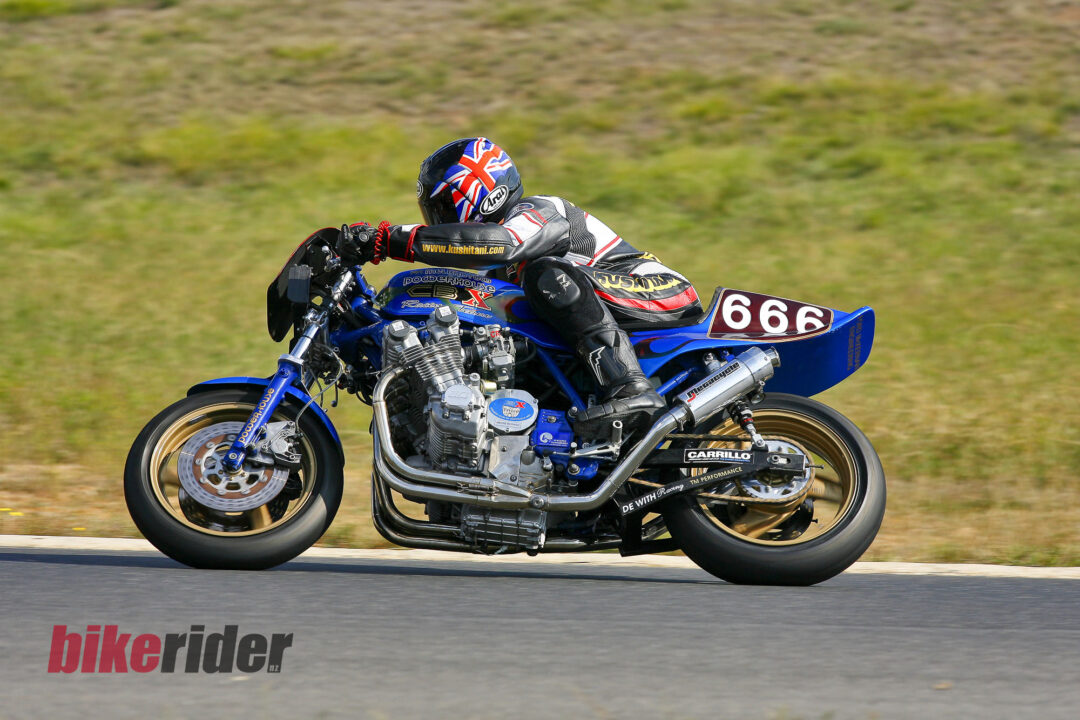
But in terms of handling, you soon forget you’re riding such a wide six-cylinder package. It simply doesn’t feel as bulky on the move as you expect it to.
The aerodynamics are actually better than they have any right to be. While the slab-sided engine certainly pushes a lot of air, the rider gets tucked in behind it, minimising drag to some extent.
More importantly, the CBX’s handling was frankly astonishing.
It steers far more sweetly and precisely than I expected, especially in slower corners where it turns willingly toward an apex without requiring excessive effort on the bars.
It brakes well from high speed too, especially considering all that extra weight. The locally made cast-iron discs provide impressive stopping power, while the rearward weight bias keeps everything stable under hard braking.
The Beast is very stable on the brakes, and the six-cylinder engine’s reduced inertia compared with a larger-capacity four means engine braking is remarkably smooth.
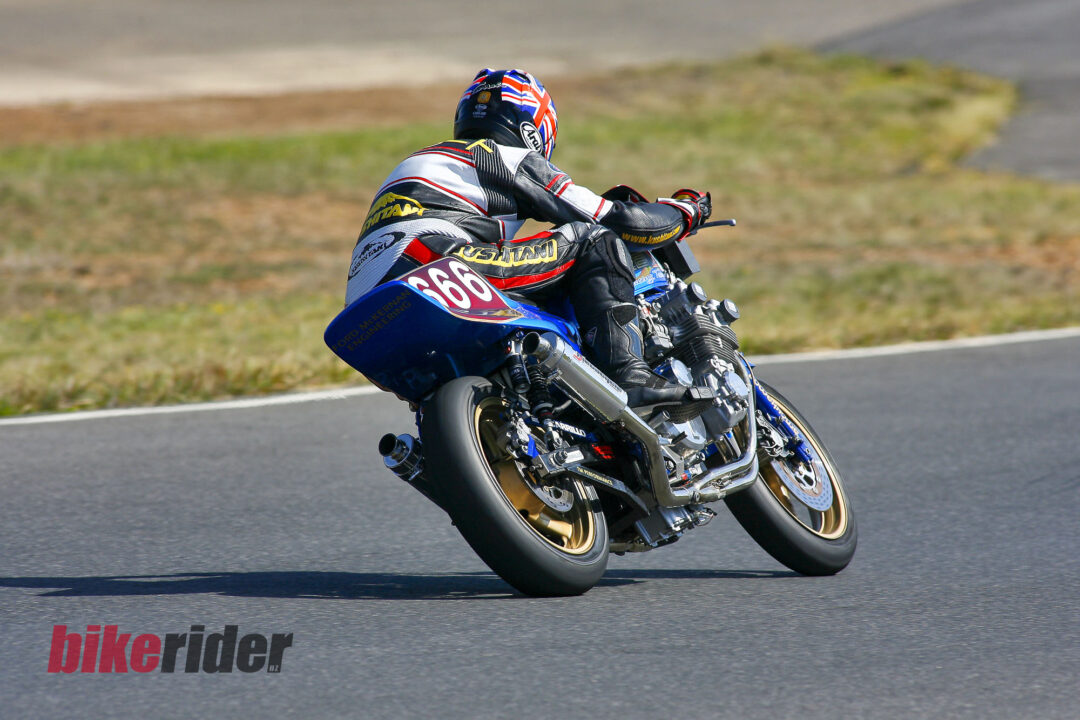
Then there’s the engine.
That silky-smooth 130bhp motor is a surprise because its ultra user-friendly power delivery makes it easier to ride in tight, twisty sections than many more powerful but peakier four-cylinder rivals.
It really comes alive from 5,800rpm and then continues building power in an entirely linear fashion right through to the limiter.
The performance is accompanied by the melodic soundtrack of the Megacycle exhaust system. Not the shrieking scream of a Grand Prix six, but a rich, mechanical six-cylinder howl all of its own.
Because you can feel the power building constantly, Michael Dibb advised me to redline the engine in every gear.
He was right.
The more you rev it, the better it gets.
The gearshift is positive, the clutch surprisingly manageable, and the entire package far more civilised than something this outrageous has any right to be.
However, I still reckon that progressive power delivery is just a little too friendly.
The CBX could use a slightly more aggressive hit coming out of slower corners. Another lightweight crank, a little more compression and perhaps a more aggressive cam profile would likely sharpen things considerably.
Even so, The Beast remains remarkably effective.
For this totally improbable piece of two-wheeled hardware is paradoxically at its best in tight turns rather than fast sweepers.
Pouring on the power while cranked over didn’t faze the chassis at all, provided the surface was smooth.
The only truly dramatic moments came over Broadford’s bumps and crests, where the CBX would occasionally shake its head violently before somehow sorting itself out.
“It gets a little physical there,” Michael told me with typical understatement.
“But we just hang on and sort it out.”
The Explosive Finale
A second session later that day was cut short when a cylinder stud broke in the engine.
Even though I clutched it immediately as the camchain failed and the motor suddenly went off-song, the damage was still considerable.
Eighteen bent valves out of twenty-four.
So now you know why Roland buys them in China.
But after riding this completely improbable yet surprisingly effective road racer, I have to say I’m surprised Honda never pursued endurance racing seriously with the CBX during its heyday.
Yes, the extra cylinders would have meant more fuel stops, but the smoothness and performance might easily have compensated.
Plus, that silky six leaves you surprisingly fresh after a session. You feel ready to jump straight back on and do it all again.
“I built The Beast in 1993, but it took almost 20 years for us to achieve what we’d set out to do, and scare the established players,” says Roland.
“If I die now, I’m content.
“Although on saying that, I still have some ideas that I’d like to bring to fruition.
“Now I’m aiming to build a 1233cc methanol-fuelled Pro-Link-framed Beast, and let’s see if that gets us to the finish line first.”
Don’t bet against it, especially with Michael Dibb aboard.

Honda CBX Racer Specs
| Engine | 1147cc air-cooled DOHC inline six |
| Power | 130bhp @ 9600rpm (rear wheel) |
| Torque | 97.6Nm @ 8000rpm |
| Carburettors | 6 x 31mm Keihin CR-S |
| Transmission | 5-speed |
| Weight | 227kg (with oil and 10L fuel) |
| Frame | Modified Honda CBX |
| Suspension | Showa forks / Wilbers-WP twin shocks |
| Brakes | Twin 300mm cast iron front discs |
| Top Speed | 250km/h |
| Owner/Builder | Roland Skate |
| Rider | Michael Dibb |
Honda CBX – Wide Boy
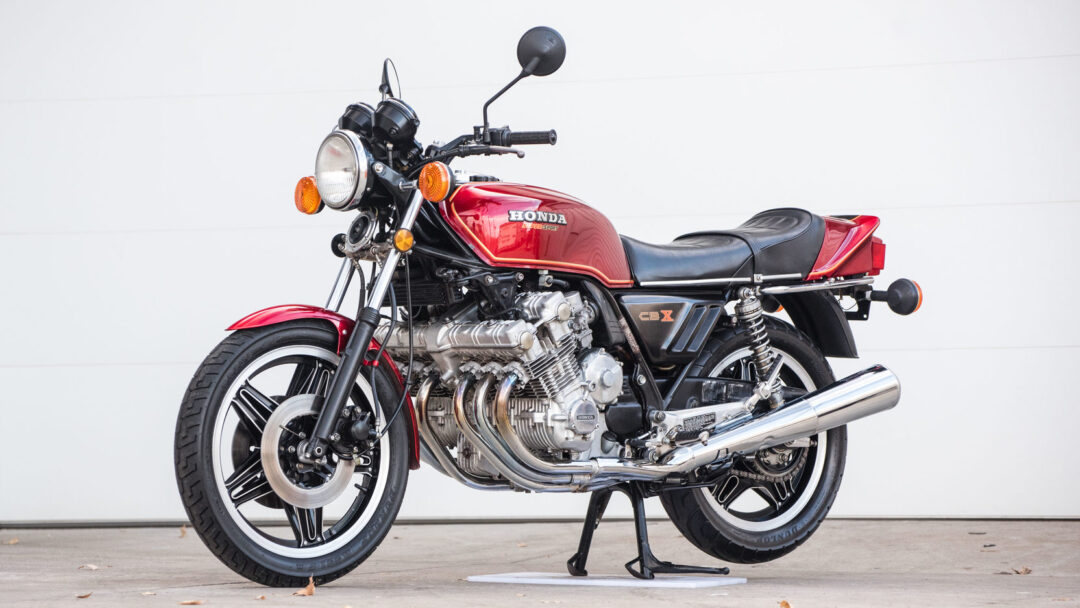
When Honda launched the CBX at the end of 1977, it represented one of the boldest engineering statements the motorcycle industry had ever seen.
At its heart sat a magnificent air-cooled 1047cc DOHC 24-valve inline six producing a claimed 105bhp at 9000rpm. Designed by Soichiro Irimajiri, the engineering genius responsible for Honda’s iconic six-cylinder Grand Prix racers of the 1960s, the CBX combined genuine racing pedigree with road-going practicality.
The numbers were staggering for the era. A top speed of 225km/h and an 11.36-second quarter mile made it one of the fastest motorcycles money could buy, while its turbine-smooth power delivery and unique six-cylinder soundtrack gave it a character all its own.
Honda built more than 41,000 CBXs between 1978 and 1982 in several different versions, ranging from the original naked roadster through to the later sports-touring models. Despite its engineering brilliance, however, the CBX never sold in the numbers Honda had hoped for, and production eventually ceased in 1982.
Today the CBX enjoys cult status among enthusiasts worldwide. Original examples are highly sought-after collector bikes, while the engine remains one of the most charismatic powerplants ever fitted to a production motorcycle.
Which makes Roland Skate’s decision to turn one into a race-winning vintage superbike all the more impressive.