


- Learn the five geometry measurements that have the biggest effect on motorcycle handling.
- Discover simple garage adjustments that can transform the way your bike steers.
- Suspension expert Leroy Rich busts common myths about geometry and setup.
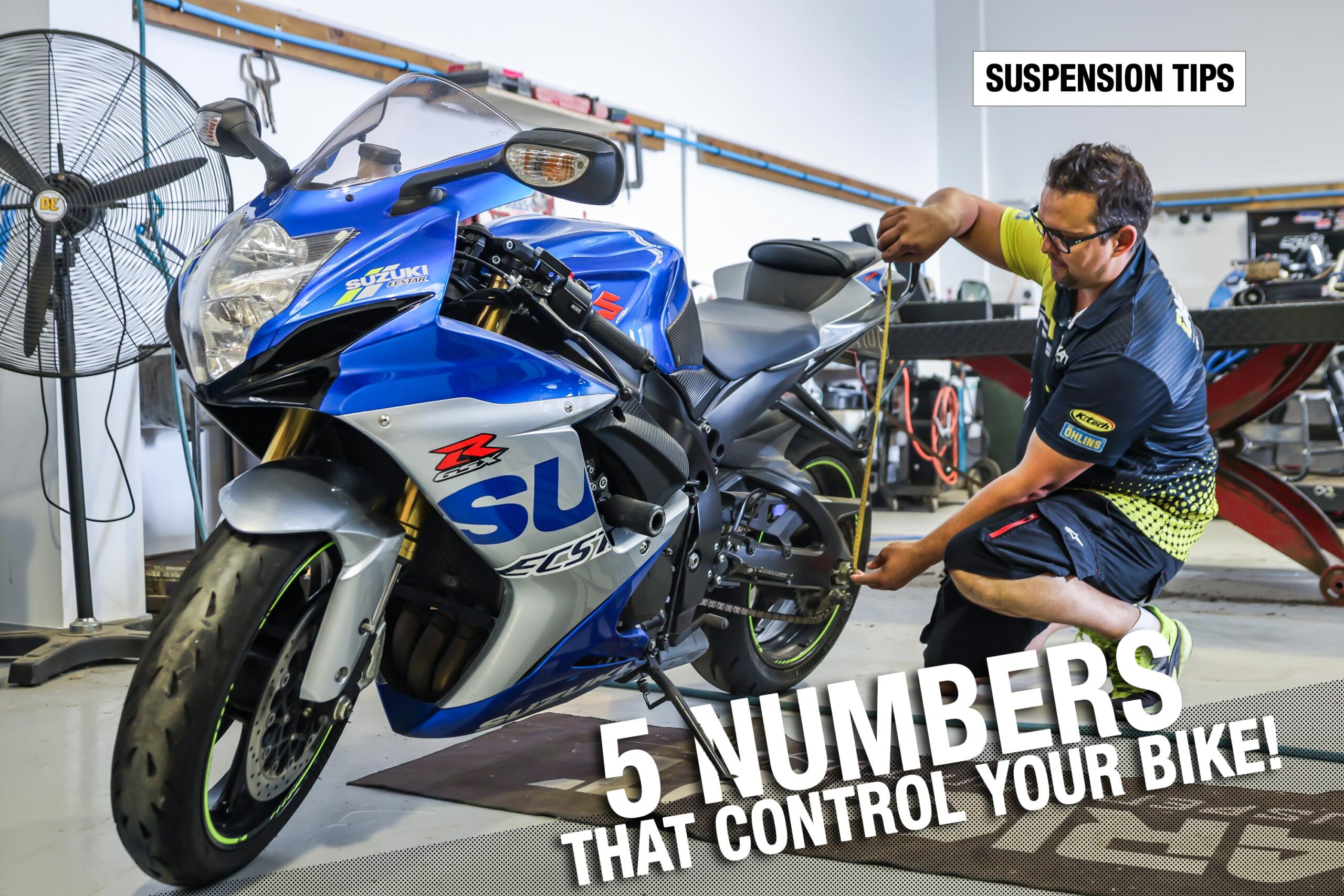
Motorcycle Geometry Explained: The Five Numbers That Control Your Bike
Think your tyres or suspension are causing your bike’s handling problems? Darkart Suspension’s Leroy Rich explains why geometry is often the real culprit—and how a few simple adjustments can completely transform the way your motorcycle rides.

It’s Not Always the Tyres
Ever come back from a ride thinking:
“This thing just won’t turn in.”
“It feels nervous on the brakes.”
“It won’t hold a line through the corners.”
The first thing we usually do is blame the tyres. Then the suspension. Then the suspension tuner. Then maybe the road.
But a lot of the time the real problem is much simpler.
It’s geometry.
MORE ARTICLES



Geometry is simply the shape of your bike – head angle, wheelbase, and where the weight sits. You can’t see it working, but you feel it in every single corner.
The good news? You don’t need an engineering degree to understand it, and you don’t necessarily need to buy expensive parts to change it (although an aftermarket shock certainly opens up more adjustment).
Just a few millimetres here and there can transform a bike from something you’re constantly fighting into one that does exactly what you want.
Here are the five numbers that really matter and, more importantly, what they actually feel like on the road.
The Five Numbers That Matter – In Plain English
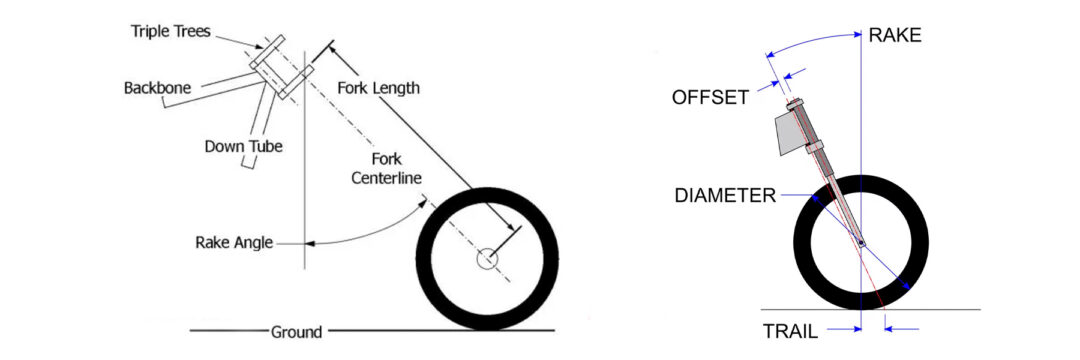
1. HEAD ANGLE: How quickly it steers
This is how far forward your forks lean.
A steeper head angle means the forks are more upright. A slacker head angle means they lean further forward.
Steeper head angle
- Bike drops into corners quickly.
- Feels light and sharp.
- Can feel nervous in a straight line.
Slacker head angle
- Bike feels calmer and more stable.
- Takes more effort to turn.
- Holds a line better at speed.
Think shopping trolley wheel versus a chopper. Same idea.
2. TRAIL: How much it wants to straighten up
Trail is what makes the front wheel naturally want to go straight when you let go of the bars.
More trail
- Heavy, stable steering.
- Great on the open road.
- Takes more effort to turn.
Less trail
- Light, quick steering.
- Flicks from side to side easily.
- Can feel twitchy.
This is why a sports bike feels completely different to a cruiser.
3. WHEELBASE: How long the bike is
Simply the distance between the front and rear axles.
Long wheelbase
- Planted.
- Calm.
- Great with a pillion or luggage.
- Slower to change direction.
Short wheelbase
- Turns quickly.
- Feels playful.
- Can get light on the front under hard acceleration.
Moving your rear wheel back just 4mm with the chain adjusters changes this.
4. SWINGARM ANGLE: How it drives out of corners
This is the angle of the swingarm relative to the swingarm pivot.
Flatter swingarm
- Bike squats when you open the throttle.
- Feels stable.
Steeper swingarm
- Bike tries to lift and drive forward.
- Better drive out of corners.
- Can feel busier.
You change this by raising the rear ride height or fitting a taller rear tyre.
Tech Tip: Most OEM shocks don’t have rear ride-height adjustment. Making this change usually requires an aftermarket shock.
5. RIDE HEIGHT / WEIGHT BALANCE: Where the weight sits
More weight over the front tyre helps the bike turn in.
More weight over the rear makes it feel more stable.
The easiest adjustment is sliding the forks up 2mm through the triple clamps. That shifts more weight onto the front and sharpens the steering.
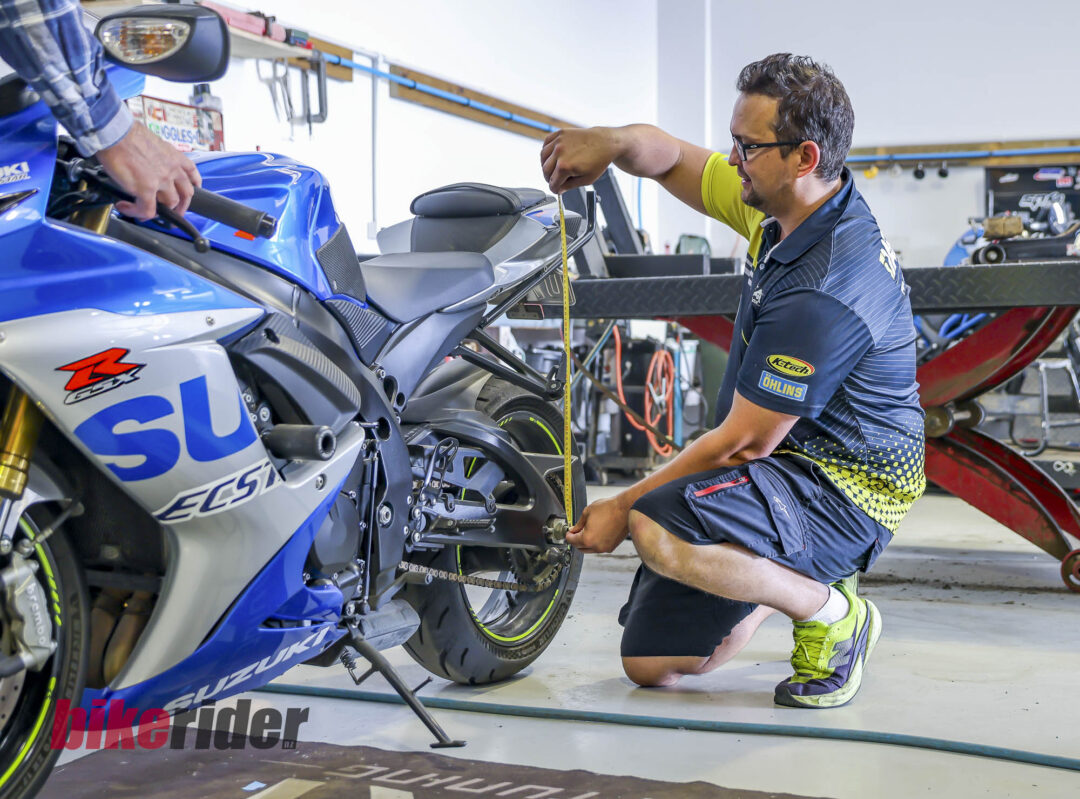
How to Change It in Your Own Garage
You don’t need a workshop.
You need an Allen key, a tape measure and about 20 minutes.
1. Fork height in the triple clamps
This adjustment is possible on almost every motorcycle.
Loosen the triple clamps and slide the forks up or down 2mm.
Forks up 2mm
- Turns in easier.
- Good if the bike feels lazy.
Forks down 2mm
- Calmer on the motorway.
- More stable over bumps.
Mark the original position with a pen before making any changes.
2. Rear ride height
Most OEM shocks are a fixed length.
If you have an aftermarket shock with ride-height adjustment, just 2mm of change can noticeably alter the handling.
No adjuster?
You still have two options:
- Fit a taller rear tyre. Moving from a 190/55 to a 190/60 raises the rear by around 6mm, altering the bike’s geometry.
- Fit an aftermarket shock.
3. Chain adjustment = wheelbase
Wheel further back:
- More stable.
- Slower steering.
Wheel further forward:
- Quicker steering.
- Better in town and on tight roads.
Rule: Change one thing at a time. Ride it. Write it down.
Quick Troubleshooting Guide
| If your bike feels… | It probably means… | Try this… |
| Heavy to turn in, runs wide | Fighting it in corners | Slide forks up 2mm. If fitted, raise the rear ride height 2mm. |
| Nervous on the motorway | Too twitchy at speed | Slide forks down 2mm. If fitted, lower the rear ride height 2mm. |
| Front feels vague under brakes | Not enough weight over the front | Slide forks up 2mm. |
| Spins up on corner exit | Not driving forward | Taller rear tyre or an aftermarket shock with more ride height. |
| Tiring in city traffic | Steering too slow | Move the rear wheel forward 4mm in the adjusters. |

Three Things to Try This Weekend
1. Find your baseline
Measure your current fork height at the triple clamps.
Do the same at the rear.
Now you can always return to where you started.
2. The 2mm test
Slide the forks up 2mm.
If you have an aftermarket shock, try raising the rear by 2mm as well.
Ride your favourite loop.
Is it easier to turn?
Does it inspire more confidence?
If not, simply put it back.
3. Check your tyres match
A worn, flattened front tyre paired with a new rear can make a bike feel strange.
Likewise, changing from a 190/55 to a 190/60 rear tyre raises the rear by around 6mm, changing the bike’s geometry.
Geometry Myths Busted
Myth 1: “Lower is always better for handling.”
No. Too low and the bike becomes nervous over bumps and under brakes.
Myth 2: “You need expensive parts to fix handling.”
Not true. Moving your forks by just 2mm costs nothing.
Myth 3: “Set the sag and you’re done.”
Sag is important. Ride height is what changes the steering.
Myth 4: “Factory settings are perfect.”
They’re a compromise designed for an “average” rider. You’re probably not average.
Myth 5: “I can adjust rear ride height on my standard bike.”
Most OEM shocks are fixed length. Changing rear ride height usually requires an aftermarket shock or a different tyre profile.
Wrap Up: Geometry Doesn’t Lie
Get the geometry right and suddenly the bike feels like it’s working with you instead of against you.
Braking becomes calmer. Corner entry feels easier. The bike holds a line without you constantly fighting it.
You don’t need to understand all the physics. Just remember: make small changes, test them and write everything down.
Do that, and you’ll be safer, more confident and have a lot more fun every time you ride.
If you’d like more suspension advice, make sure to check out Leroy and Darkart Motorsport.
https://www.darkartmotosport.co.nz
tel:+64212032563