

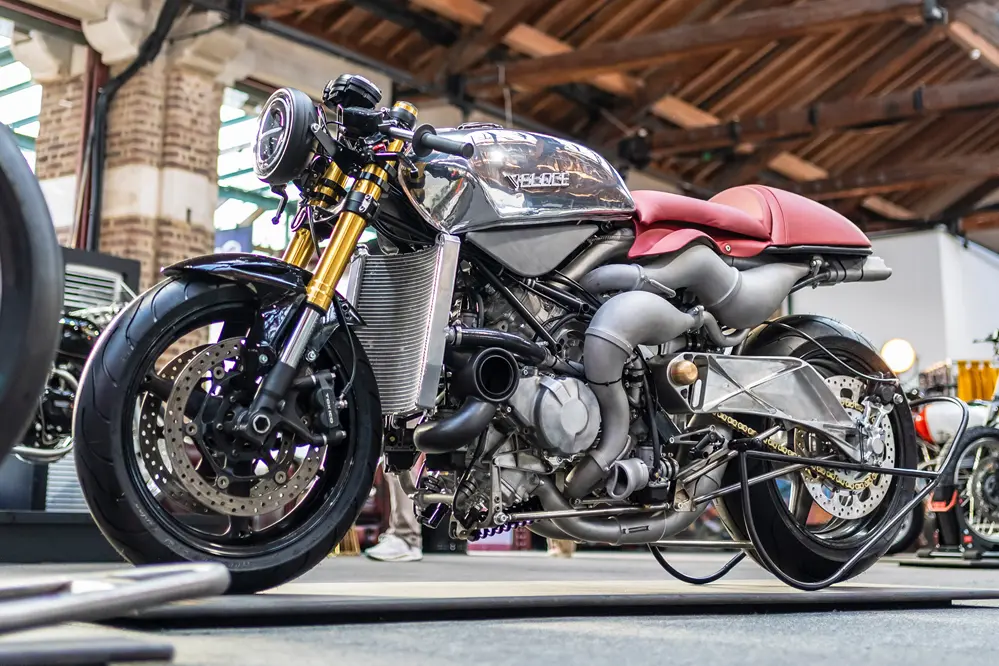
In an era dominated by emissions regulations, electrification and increasingly sophisticated four-stroke engines, a brand-new two-stroke motorcycle is already a rare sight. But an eight-cylinder, 1,000cc two-stroke producing a claimed 280bhp? That’s the sort of engineering madness most people thought had disappeared decades ago.
Yet that’s exactly what Oxfordshire-based startup Veloce Motorcycles has created with the Aperion, an extraordinary naked bike that made its public debut at the Bike Shed Moto Show in London. Rather than designing an engine entirely from scratch, Veloce has cleverly built its powerplant around eight Rotax/Aprilia RS125 cylinders, each fitted with forged Mitaka performance pistons and arranged into two separate V4 crankcase assemblies around a central transmission housing.
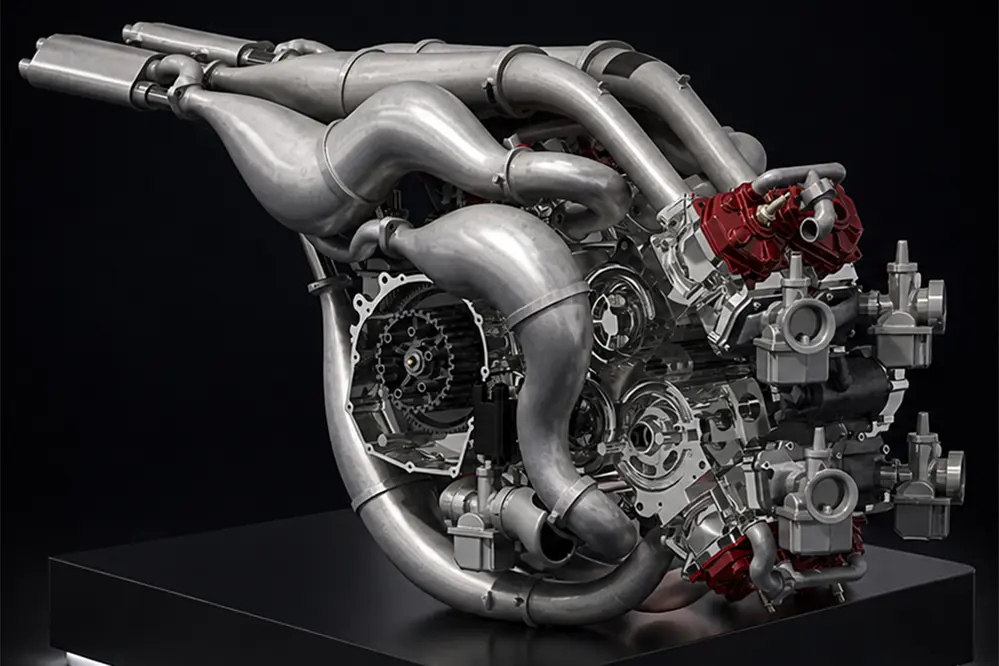
The engineering is as fascinating as it is unconventional. Each cylinder bank is machined from billet aluminium in four separate sections and houses two crankshafts, all geared together through a common jackshaft that drives a bespoke clutch and transmission. Fuel is supplied by four pairs of 24mm Dell’Orto carburettors, controlled through an ingenious eight-cable spiral throttle mechanism that opens all eight carburettors simultaneously. Like any proper high-performance two-stroke, the engine runs on premixed petrol and two-stroke oil.
Veloce claims the engine produces around 280bhp, equating to roughly 35bhp from each of the eight 125cc cylinders. While that’s an extraordinary figure, it’s not entirely unrealistic considering the performance potential of highly tuned RS125-based race engines.
Perhaps the most impressive aspect of the project, however, is the exhaust system. Expansion chambers are critical to extracting maximum performance from any two-stroke engine, with each pipe requiring precisely calculated lengths, diameters and cone angles to achieve the desired power characteristics. Packaging a pair of these pipes is difficult enough, while fitting four has challenged Grand Prix engineers for decades. Somehow, Veloce has managed to package eight.
The solution lies in modern manufacturing. Rather than fabricating each chamber from dozens of individually welded steel sections, the company uses laser-sintered 3D printing to produce the complex exhausts directly from CAD designs. This allows the chambers to be optimally shaped around the engine and chassis while remaining lightweight and exceptionally compact, something that would have been virtually impossible using traditional fabrication techniques.
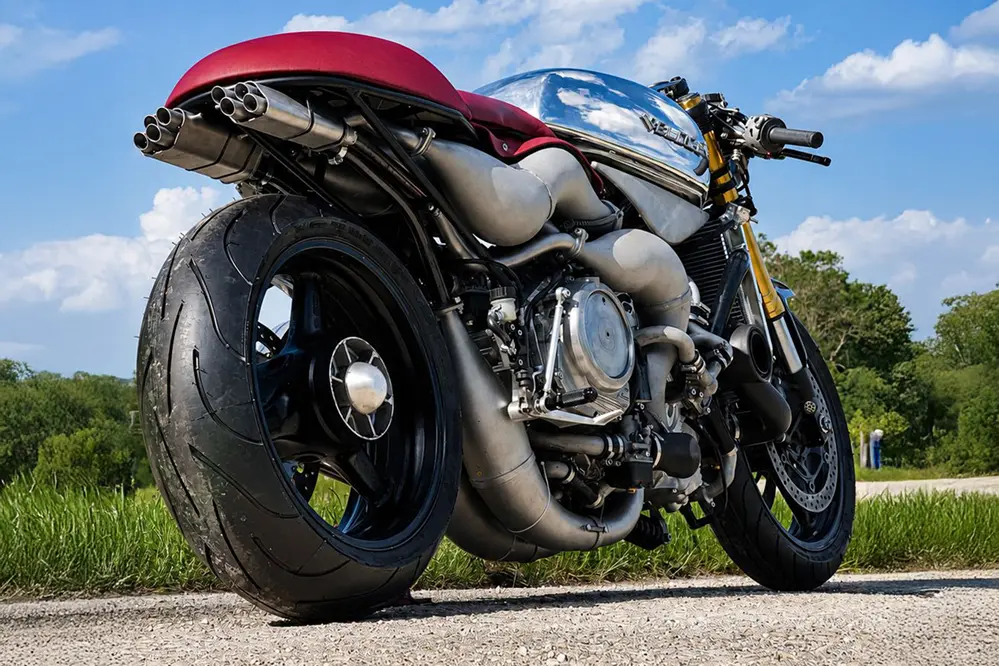
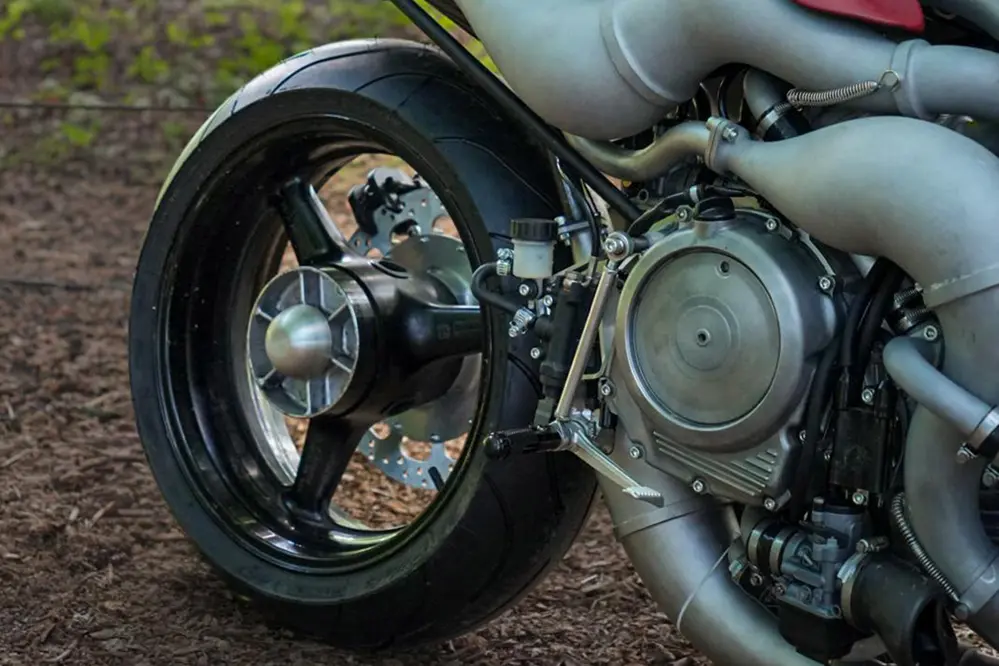
The chassis itself is equally unconventional. Instead of surrounding the engine with a conventional frame, the massive V8 powerplant acts as the motorcycle’s stressed structural member. Welded steel birdcage-style trellis subframes support the front and rear of the bike, while a substantial single-sided aluminium swingarm mounts directly to the engine cases. Rear suspension is controlled by a tie-rod-operated monoshock mounted beneath the front of the engine, with conventional upside-down forks handling suspension duties at the front.
In a motorcycle industry increasingly driven by efficiency and regulation, Veloce’s extraordinary V8 two-stroke serves as a reminder that there’s still room for bold, unapologetically ambitious ideas.