
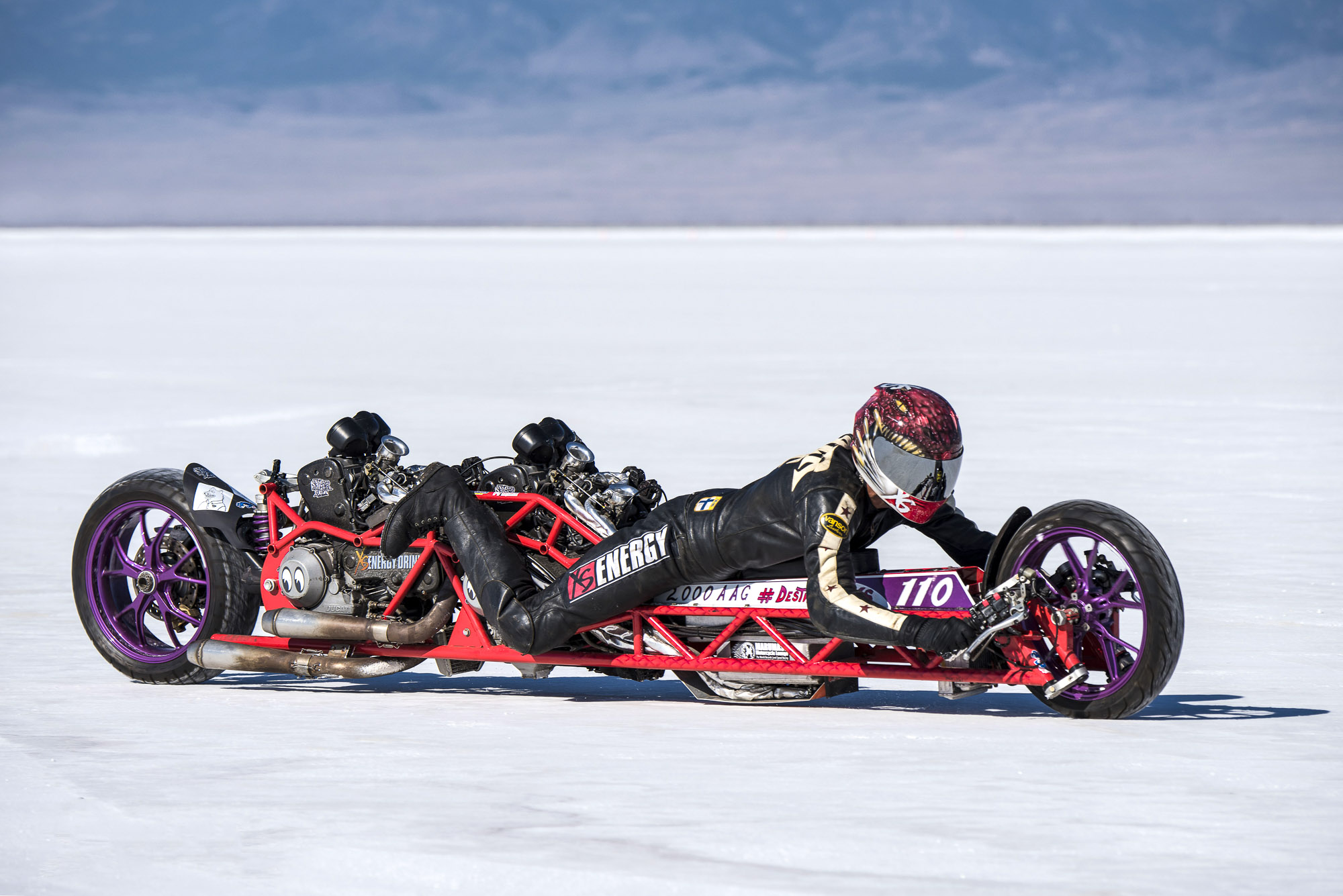
- Twin Ducati engines combined to chase the elusive 200mph Bonneville mark
- Built in just eight months with virtually no testing before racing
- A record-breaking run that still stands more than a decade later
Salt fever is a sickness for which there’s only one cure – more of the same. Alan Cathcart tells the story of Mark Bjorklund’s outrageous twin-engined Ducati and its quest for 200mph on the Bonneville Salt Flats.
Salt Fever
Salt fever is a sickness for which there’s only one cure – more of the same! – and a decade ago two-time record-breaker Mark Bjorklund, from Bellingham, Washington, caught the Bonneville bug big-time. Soon as you set one speed record on the Utah Salt Flats, you’re already planning how to go faster next year with something different – as well as how to fund building it!
Set on the Pacific Ocean in the USA’s top left hand corner, just a long stone’s throw from the Canadian border, Bellingham was formerly best known in bike terms as the home town of former Formula 750 World champion road racer Steve Baker, whose huge Yamaha dealership dominates the local two-wheeled scene. But in 2012, Mark Bjorklund grabbed local headlines by setting a new 1000cc A-AG (altered frame, with a normally aspirated engine, running pump gas) speed record at 166.360mph on the Team Super Rat Ducati S4RS Monster-based special, created in the eponymous custom shop run by him and his brother Carl in Bellingham.
Until then, despite being the dominant European road racing brand for so many years, Ducatis had always been strangers to the Salt, with sightings of desmo V-twins at America’s annual festival of speed comprising the Bonneville Speed Trials only very rare. But in setting an improbable desmodromic speed record on his much-modified 999cc desmo V-twin S4RS Monster, a 2007 bike which officially became the World’s Fastest Monster, Bjorklund demonstrated that you don’t need to have copious sponsorship and liquid money to be successful in the pursuit of speed.
Yet nothing comes easy, and to create his record-breaking motorcycle Bjorklund had to invest serious time and ingenuity, relying on the help of his brother Carl and Jason Omer, plus their friend Tim Clossey. But having achieved his ambition of writing his name in the record books in 2012, it was back to the day job helping maintain the Electron Hydroelectric Project, in between running Super Rat Customs in what spare time he had. But the dream of returning to the Salt Flats with another bike to go after a different set of records was never far from his mind – Salt Fever, right?! Let’s leave it to Mark to explain to us What Happened Next.
The Idea
“I had so many customers at Super Rat keeping me busy aside from my full time job at Electron Hydro, that it was impossible to focus on returning to Bonneville,” says Mark. “However, I was thankful for the work, and it did provide an income to help fund our Landspeed projects. But after our successful visit to the Salt Flats in 2012, it wasn’t until January of 2014 that I could begin construction of the next bike. But what to build?”
“Well, here I need to go back in time to 2006. I had studied the new Ducati Monster S4RS and it seemed absolutely brilliant. I had to have one – but it seemed selfish. My brother Carl and I had worked together on projects for 20 years, and we’re always doing stuff together. I had just finished pouring a huge concrete project where Carl had spent three months with me tying all the rebar, and for most of that time he’d been hanging off scaffolding. The job had been very profitable, and it seemed like the best idea was to squander the profits immediately on two brand new motorcycles! So I bought a red 2007 S4RS Monster for myself, and a white one for Carl.”
“These quickly became our favourite bikes, and we kept them perfect while using them hard. They both got some aftermarket goodies, and matched one another on the dyno with 128bhp each at the wheel. Desmo perfection!”
“OK – so now, back to 2014. I’d lain awake at night for three months prior to this moment, going over every detail in my head about how to build a bike that I could run over 200mph on at Bonneville, and join the 200 MPH Club. To begin with, though, I was only planning on using a single laydown engine. But then when I got to playing with a tape measure on the Ducati motor, a light bulb went off in my head – what if I put two Ducati engines together for this thing?? Yes! And so it began.” I asked Carl if I could borrow his Monster motor for a project I had in mind, and he thought it was a great idea. So I was off and running – plus, I’d be going after the 2000 A-AG record, which’d mean I wasn’t trying to beat my own 1000 A-AG speed, and that was nice!”
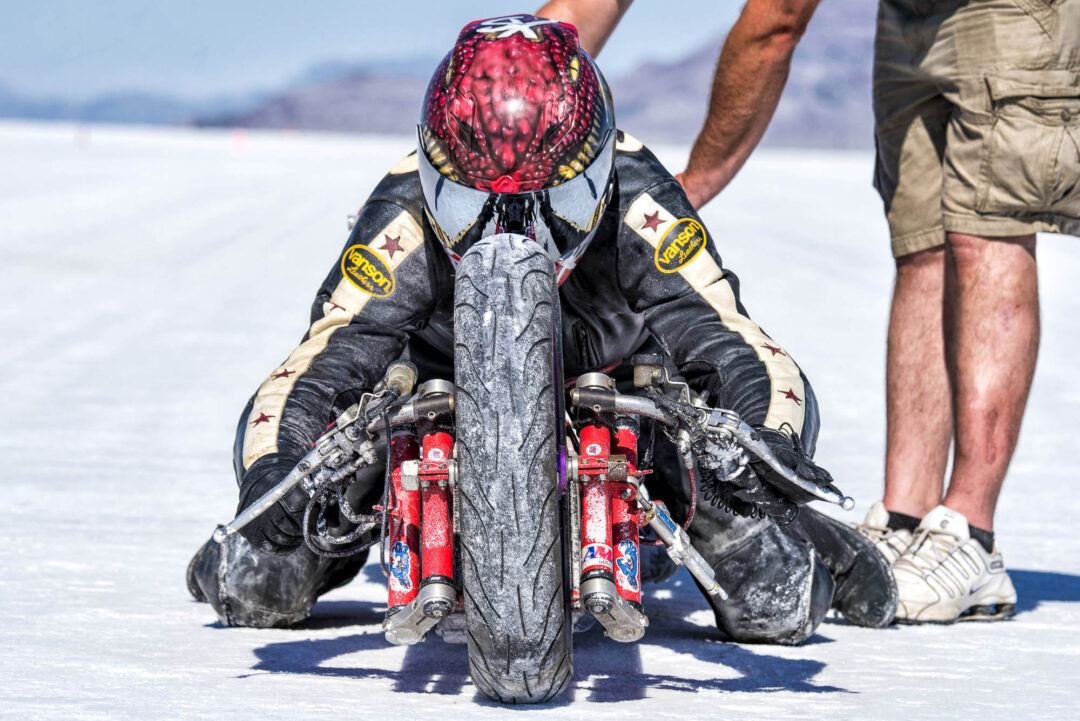
“In fact, we’d already built a twin-engined Yamaha in 2012 with two YZ80 two-stroke motors [see it on YouTube at https://www.youtube.com/watch?v=W_vqlZ5KjQI ] for the 175cc A/AG class so the concept wasn’t entirely new. and the concept for that began with us asking ourselves – how do we eliminate the front headstock tube the fork pivots in, so we can use that frontal area for the rider’s head, and he can look over the top of the front tyre. Jason Omer had studied some photos from the 1930’s of the British OEC motorcycles that used what they called ‘duplex steering’, and a guy called Joe Wright had supposedly broken the outright Land Speed Record with a bike fitted with this. Apparently, one advantage of the system was it had great stability at speed – perfect for a Landspeed bike, though the long quad “forks” needed to be much shorter to solve the frontal area issue. Anyway, Jason built the steer tubes for the ‘Yamahaz’, and we built the frame using flat aluminum plates to attach them to. It proved to be very stable, but hasn’t yet exceeded 85mph, so the stability at very high speeds was unknown.”
Building the Double-Duck
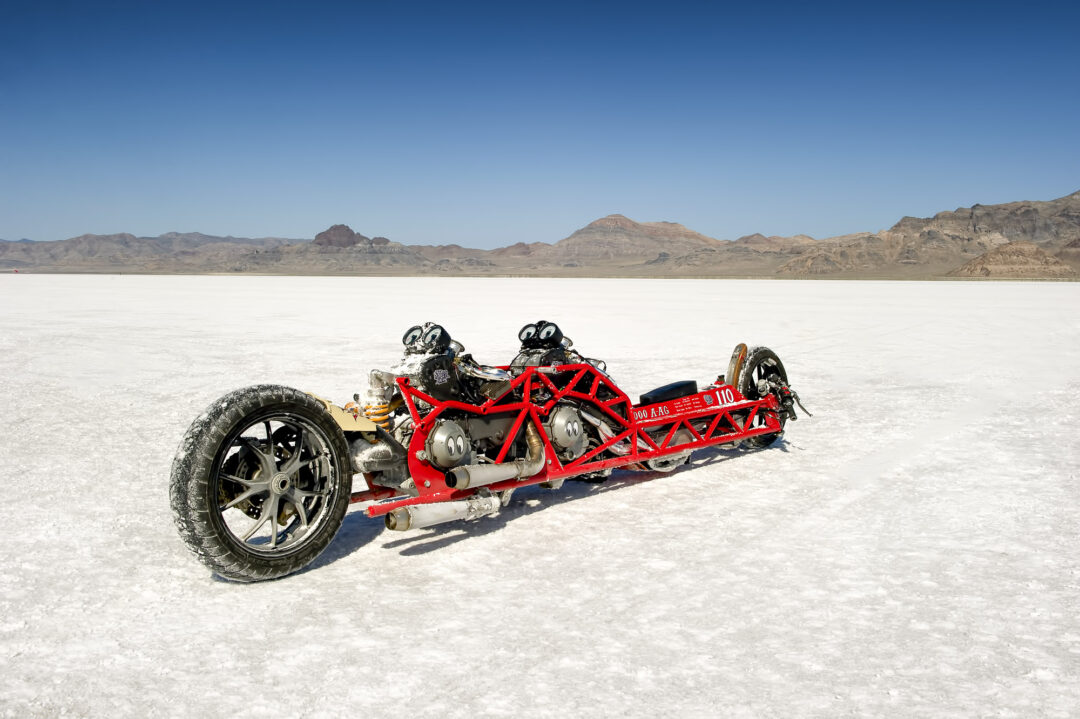
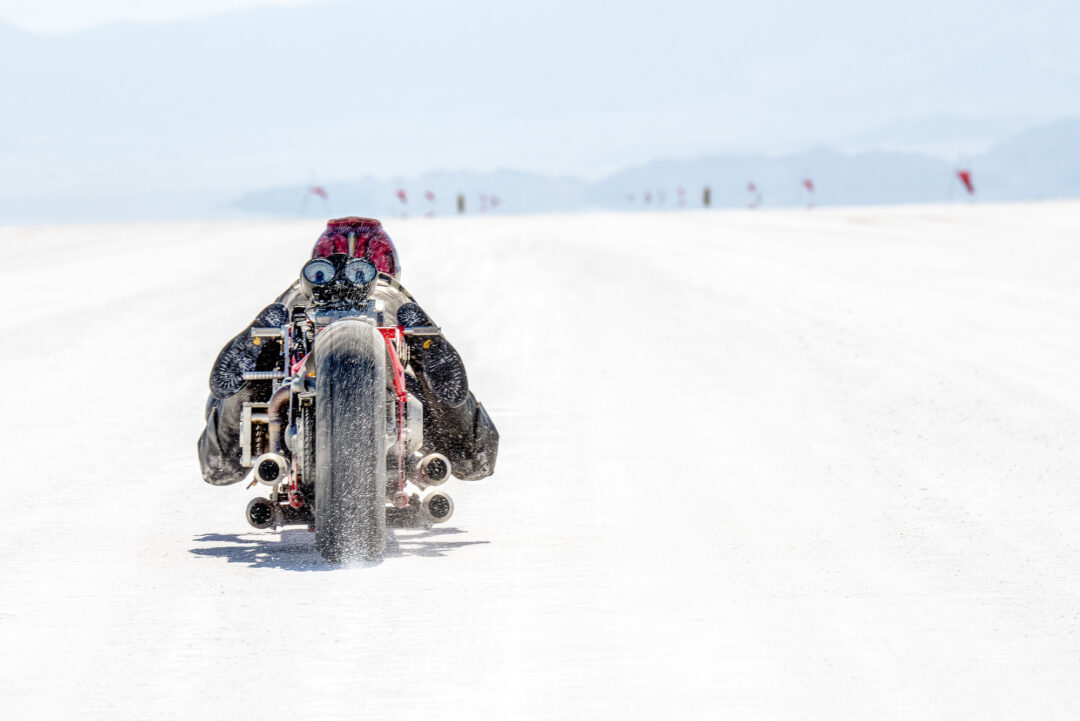
“So to construct the Double-Duck Ducati I built a jig to bolt the engines together using new frame lugs I machined to be identical to the factory lugs. I welded gussets to the front steer tubes, and ran bolts through to centre those on the frame table up front. Then I simply measured my body lying down to determine how long I needed the bike to be – it ended up with an 11-foot wheelbase, or 3.35 meters in length.”
“I rarely use more than a quick scratched drawing when I’m building something, because I believe in the motorcycle creating itself organically as it’s being built.”
“Lots of cross bracing and torsional bracing went into the frame, and the fuel cell became a structural component, along with the battery tray and top chest pad support. Everything eventually fell into place, but with two of everything – two batteries, two fuel pumps, two throttle cables, two radiators, two oil coolers and two ECU engine management computers – but four round instrument gauges because they needed to be plugged in for the engines to run! I tried getting them running and then unplugging the gauges, but they both died immediately. Each gauge package had 25 small wires, meaning I would have to cut and splice and solder a total of 100 butt joints, so I decided not to! But then I couldn’t find a reasonable location for the clocks to live, so that’s where they ended up, above each engine. Inevitably, it draws a lot of questions from people over and over again!”
Engineering the Concept
“The real head scratcher was coupling the engines together. We studied the crankshaft ends and they were tiny – so we decided to extend the countershafts off the transmissions. This would entail shifting both transmissions at the same time, but also helped keep the drive chain cool by running at a much lower rpm than off the engines.”
“I could go on and on about every little component on a totally unique motorcycle – but let’s get to the racing, which is the whole point of it all!”
Bonneville — First Attempt
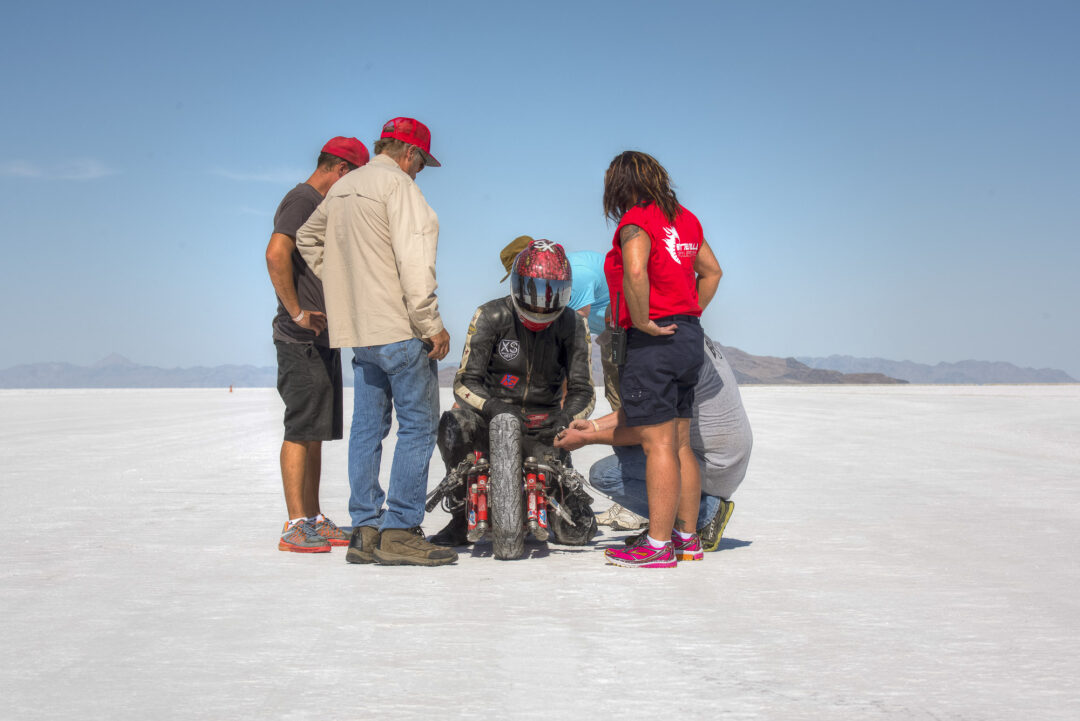
“Well, I finished tightening the last bolt exactly eight months after starting the project, and three days before the 2014 Bonneville Motorcycle Speed Trials. The bike had never been ridden.”
“I was so engrossed in the build… it’s as if I completely forgot that this thing was supposed to be speeding down the Salt Flats with me aboard it! So anyway, I rode it 30 yards up the parking lot and didn’t fall over, so then we packed it on the flatbed trailer and off to Bonneville we went.”
“The current record in 2000 A-AG at the time was around 159mph, so not having ridden it further than 30 yards before my first run, I purely wanted to test the machine and learn how to ride it.”
“It’s very awkward and uncomfortable to be lying down on your front all stretched out, with your feet above your head and the chin of your helmet six inches from the front tyre. You have zero input on anything – you just hang on tight. So I decided to go slow while I got used to this, and ‘just’ do a 100mph test, so I kept it at barely one-quarter throttle. It seemed OK, so I completed the run and then pulled off the track to find out from the course workers I’d done 169 mph. My first pass, trying to go slow, I’d smashed the record by 10 mph!”
“So I kept running for five days, and ended up with a top speed of 197mph with a return of 191, which averaged out to 193mph. OK – hugely faster than the old record, but not 200mph, which was what I really wanted. That 2014 season the salt was very wet and sloppy. Everyone struggled for traction, and the Long Course had only two miles of run-up. I was extremely happy with the results of our efforts, but I had missed the 200 mph mark that was the whole goal of this project.”
The Return and the Record
“But then two more years went by while I waited for a chance to run on the Salt Flats again… 2015 was rained out… but then finally, in 2016 we could run again.”
“For two years I had dreamed and planned in my head exactly how I would ride this motorcycle with three miles of run-up, and great track conditions. It was already a challenge to ride, and extremely difficult to handle – riding it entailed about 70% fear, and 30% fun! But the mountain stands in front of you, and you must conquer it.”
“So my two years of planning went out the window, and as soon as I got to Bonneville I changed to one tooth less in the back sprocket, which geared me for about 223mph. Older, wiser men told me not to, but I did it anyway. I think when you unload your race bike at the track you grow fangs! So I thought I would take a nice mature pass down the track to start out with, and at least learn how to ride the bike again – after all, I’d only ever made five passes down the Salt on it, and I needed to gain some familiarity with what was such an awkward machine to ride. But when you leave the line, you leave all your good intentions behind!”
“I was entering Mile 3 and I finally had the Double Duck pinned wide open somewhere around 190mph, when it spun out and pitched sideways – it was a BIG slide! In my head I started laughing… oh s**t, I’m 11 feet long, and this isn’t looking good! So I backed off the throttle a hair, and tried holding it there.”
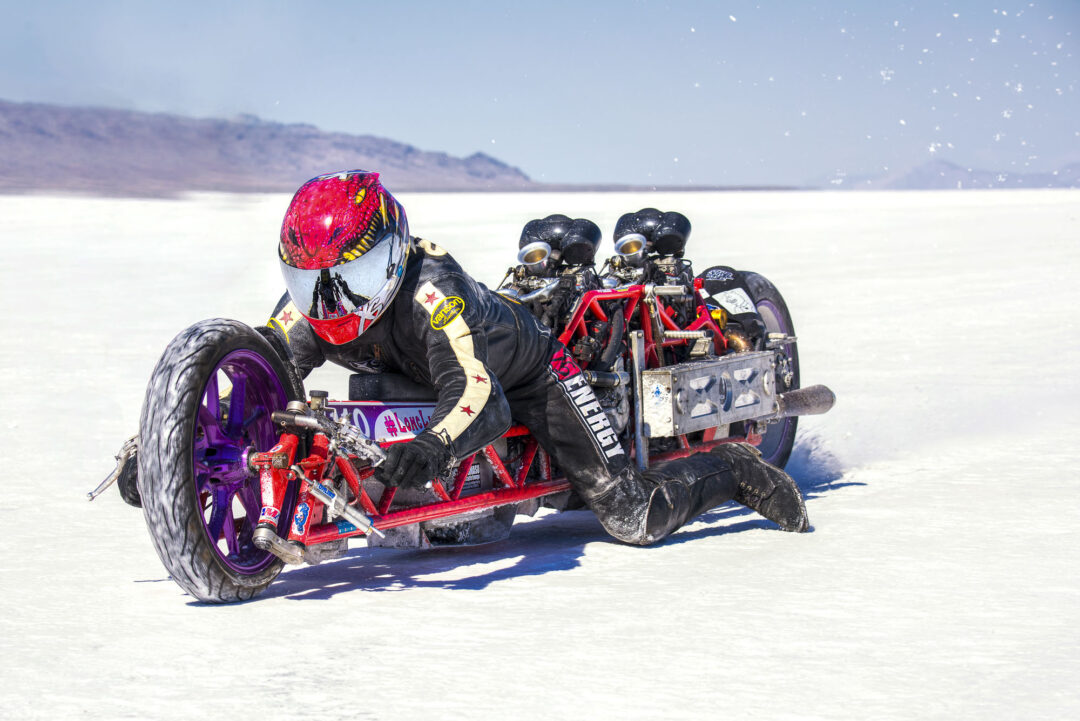
“By the time I saw the Flying Mile markers my helmet was shaking so violently I just tried to tuck it down behind the front tyre, thinking – wow, this feels like the fastest I’ve ever gone! I left the traps and slowed until I could pull off the course and stop to wait for Carl and the back-up crew to pick me up. A young lad pulled up in a truck and said, hey – want a water? Yeah, great – thanks. Did you hear the radio? He said, yeah – you did a 205!! I threw my arms into his open window and gave him a big hug, then I pointed up to the sky and said, thank you Jesus! I’m still alive, and I’m in the 200 MPH Club!”
“There are many stories I could tell about each of the runs on the bike. Most of them I couldn’t see properly because of the salt spray off the front tyre, and it’s hard to keep it straight because the horizon is always moving. It was very stable at high speeds with that steering arrangement, but you could feel the rear tyre spinning up repeatedly. I didn’t have any gauges to look at in front of me – they were out back! – so I could only go by vibration because I couldn’t hear anything but wind noise. But I’m just so happy to be alive. I went off-course twice, and ran over lots of flags, but only broke my brake reservoir, which kept falling off, so I did most of the passes with no brakes available. Didn’t seem to affect the performance at all!
“The beauty of a project like this is that it begins with one idea: ‘I wonder if I could make this work?’ Well, two engines are better than one, right? OK, so let’s try to go 200 with no streamlining – and eight months later you’re staring at the bike, and going “oh, s**t – now I have to ride this thing!” In fact, I wanted someone else to ride it so I could compare notes with another rider, but it was hard to find anyone that wanted to have a go at it! But I tell you – it feels magnificent. It’s the closest you can come to feeling like Superman!”
Mark Bjorklund’s new 2000 A-AG class AMA Land Speed Record for the flying mile with the Ducati Double-Duck still stands today, ten years after he set it, at 203.741mph (327.819km/h), with a best one-way pass of 205.827mph (331.176km/h). To put this in perspective, the current official FIM record for 2,000cc four-cylinder Unstreamlined Normally Aspirated bikes on pump gas is 209.598 mph (337.315 km/h) set by Jamie Williams on his delete-bodywork Suzuki Hayabusa in 2012, while in 2016 the twin-cylinder FIM mark belonged to Johnny Cortopassi on a Harley-Davidson VRSCR V-Rod at 176.869mph (284.644 km/h), set in 2013. So if Mark Bjorklund had gone through the bureaucracy and expense of obtaining an FIM International licence, he’d have demolished the previous Harley-Davidson twin-cylinder World Record with his self-built Ducati four-cylinder special, and given himself a good shot of beating the Hayabusa-held four-cylinder mark. “I had one run of 210.5mph on Thursday, the final day, after my record runs on the opening Sunday,” says Mark. “Unfortunately, I didn’t qualify for the return run because I missed the traps and ran off course – I was flying kind of blind from my chinstrap being too loose so my helmet slid up, and I couldn’t see where I was going for a few seconds! But I’m in the record books with that 203.741mph speed, and I’ve joined the 200 MPH Club. Hallelujah!”
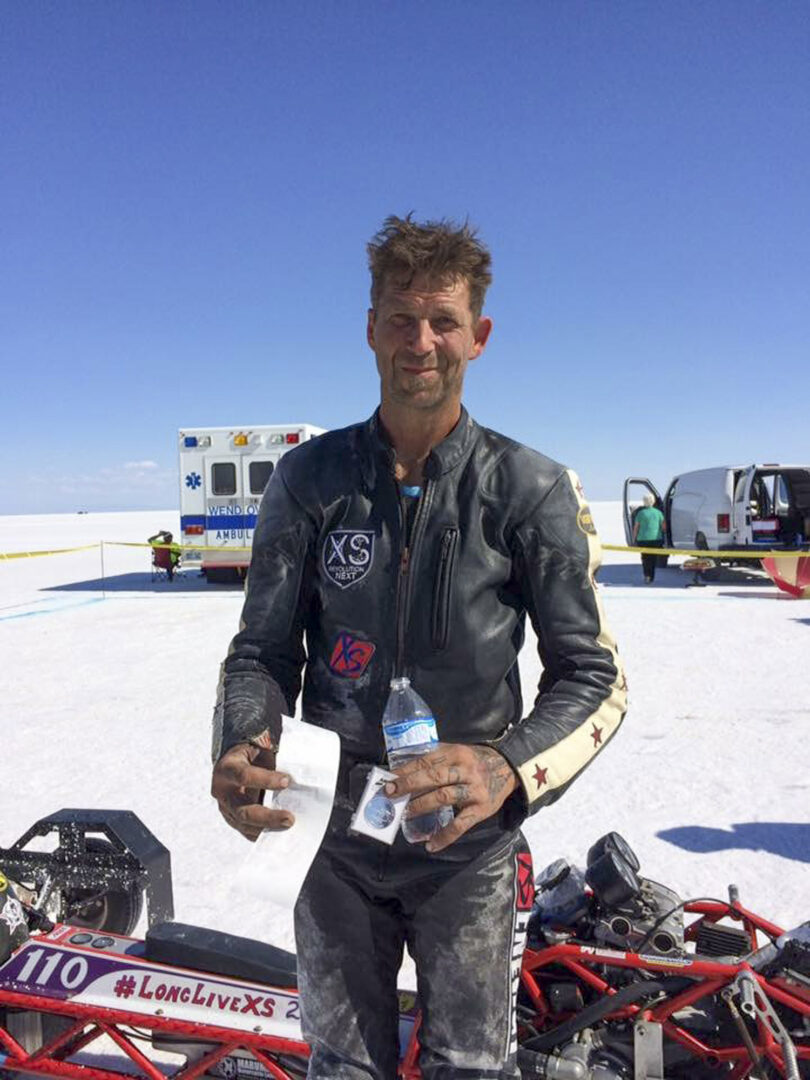
Photo credit: Phil Hawkins & Mark Bjorklund