


- MotoGP will leave Phillip Island after nearly 30 years, with Adelaide hosting from 2027.
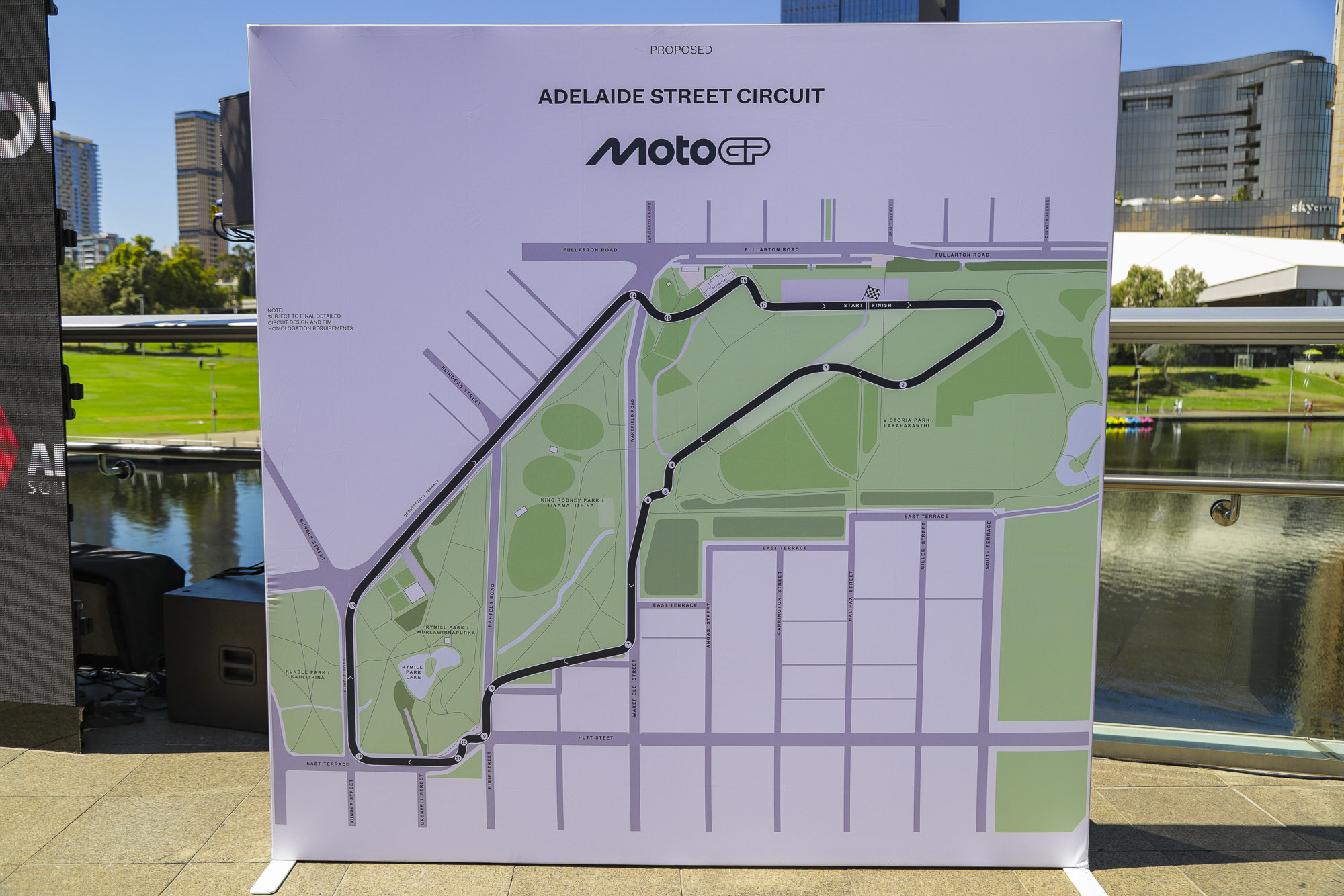
- A new 4.195km, 18-corner city street circuit will stage the first urban MotoGP event.
- The move signals Liberty’s shift toward a city-based sports entertainment model — but safety and racing quality remain big questions.
After almost three decades at Phillip Island, MotoGP is heading to a purpose-built Adelaide street circuit from 2027. Bigger crowds are promised — but at what cost to the racing?
No more MotoGP at Phillip Island…
Let that sink in for one minute. The home of the Australian GP since 1997 will no longer host a round of MotoGP after 2026.
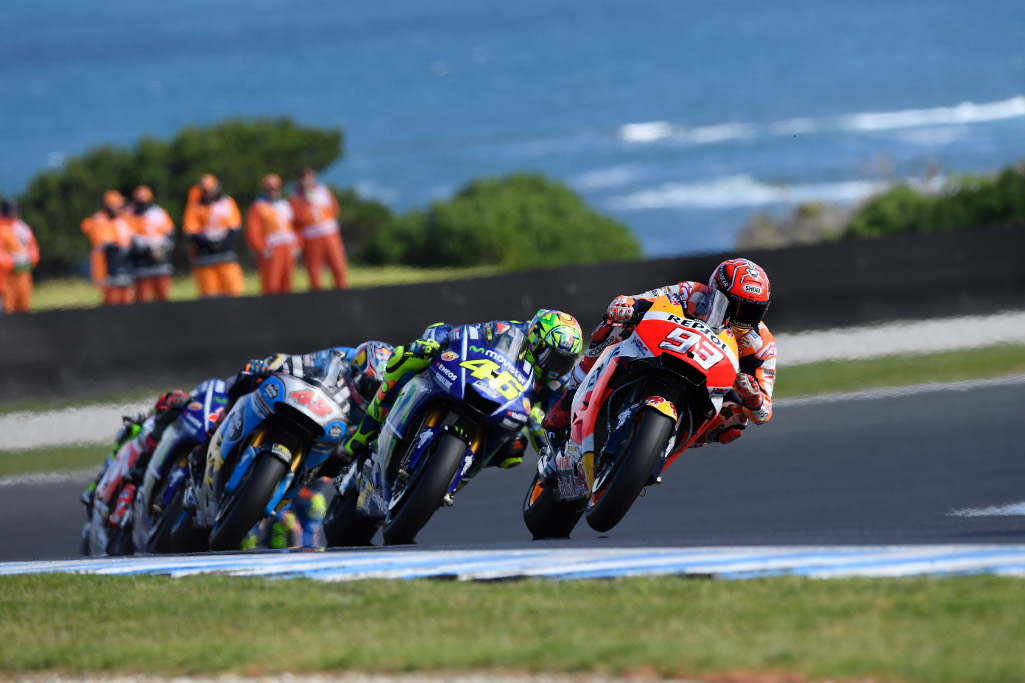
Arguably the most iconic circuit on the MotoGP calendar, the one that many racers rate as the best track on the calendar, and the one with unrivalled spectator viewing, is no longer going to host the best motorcycle racing in the world. It’s heartbreaking.
The reason for the decision seems to be somewhere between Phillip Island failing to improve the facilities for when the MotoGP juggernaut arrives in town (blame is getting passed between the track owners and the local council for this), with the pits complex hardly changing over the previous decade or two. If you want factory teams with superstar riders turning up followed by an entourage of corporate movers and shakers, toilets in a tin shed out the back just doesn’t cut it.
Then there’s the Australian Grand Prix Corporation, which essentially leases Phillip Island and negotiates with Dorna for hosting the event.
MORE ARTICLES
Yet, that appears as if it might just be a convenient excuse for the move, with Liberty Media (now known as MotoGP Sports Entertainment Group), the new owners of MotoGP, not happy with the fact that Phillip Island is almost a 2-hour drive from the major population hub of Melbourne. That means, while the crowd numbers at Phillip Island for the 2025 MotoGP race were in the region of 90,000, they know that it’s still only the die-hard fans who are going to make the trip, especially with the limited accommodation and facilities in Cowes.
Just as they’ve done in Formula 1, Liberty know they can sell MotoGP, which, face it, is about 1000 times more exciting than F1, to a whole new generation of fans. That means more money for them, more viewers for the teams, which then should result in more sponsorship, which is good for everyone. They have used this format successfully with Formula 1, where moving the race to the people offers an immediate boost in attendance while also offering close proximity to hospitality, hotels and transport infrastructure.
Sources report that Liberty wanted to Victorian government to move MotoGP from Phillip Island to Albert Park in Melbourne where they already hold a round of the Formula 1 championship in the central city, but the local government were against this as they felt the disruption to the city while setting up another race in such close proximity to the CBD would just be too much for the public to bear. Enter the South Australian government.
Adelaide has been proactively targeting big-ticket events in recent times, with the LIV Golf tournament and Tour Down Under cycling race both now in the South Australian City. And with the Australian Grand Prix now scheduled to move to the Adelaide Street Circuit from 2027, it’s a big feather in the cap of Premier of South Australia Peter Malinauskas. There’s no love lost between the two states.
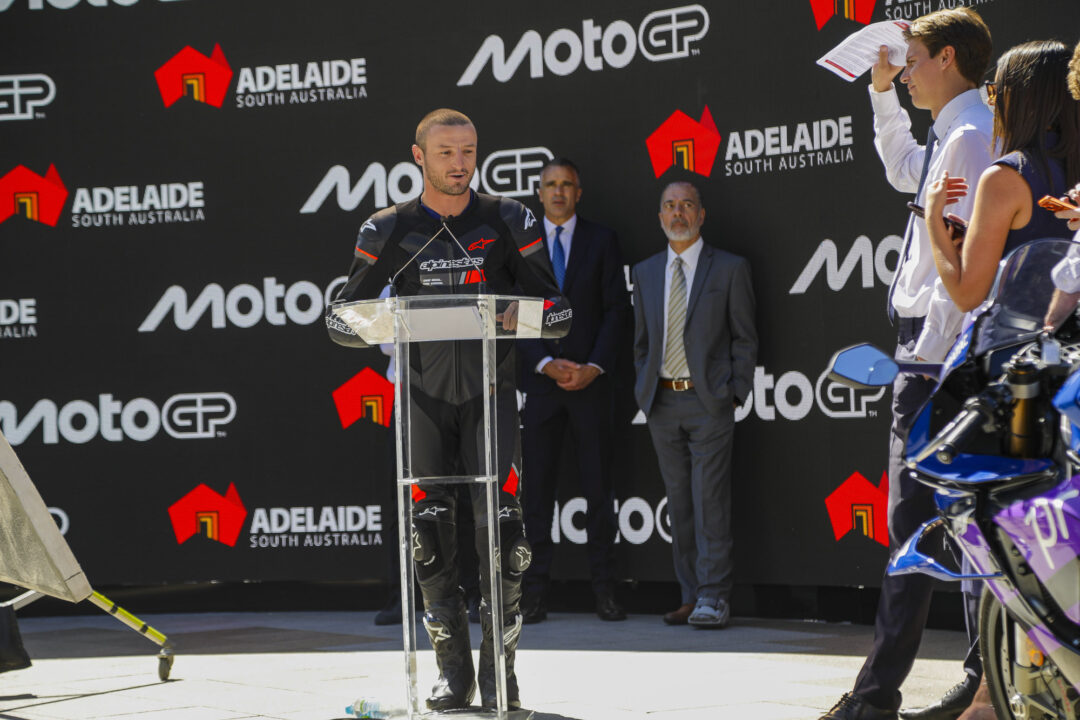
Circuit Launch
A launch for the new race location took place in Adelaide on Feb 19, with Yamaha MotoGP rider (and Australian) Jack Miller awkwardly standing in his leather next to MotoGP Chief Sporting Officer Carlos Ezpeleta and Malinauskas looking at the design of the new circuit. The inaugural Australian GP in Adelaide will be held across three days in November 2027, with the 4.195 km long circuit featuring 18 corners and winding through the city streets. The organisers claim bikes will reach speeds of more than 340 km/h.
MotoGP Chief Sporting Officer, Carlos Ezpeleta, said: “Bringing MotoGP to Adelaide marks a major milestone in the evolution of our championship. This city has a world‑class reputation for hosting major sporting events, and the opportunity to design a purpose‑built circuit in the city streets is something truly unique in our sport.”
“From the very beginning, together with the FIM, we made sure that safety remained uncompromised – every element of the Adelaide Street Circuit has been engineered to meet the highest standards of modern MotoGP, ensuring riders can race at full intensity with complete confidence.”
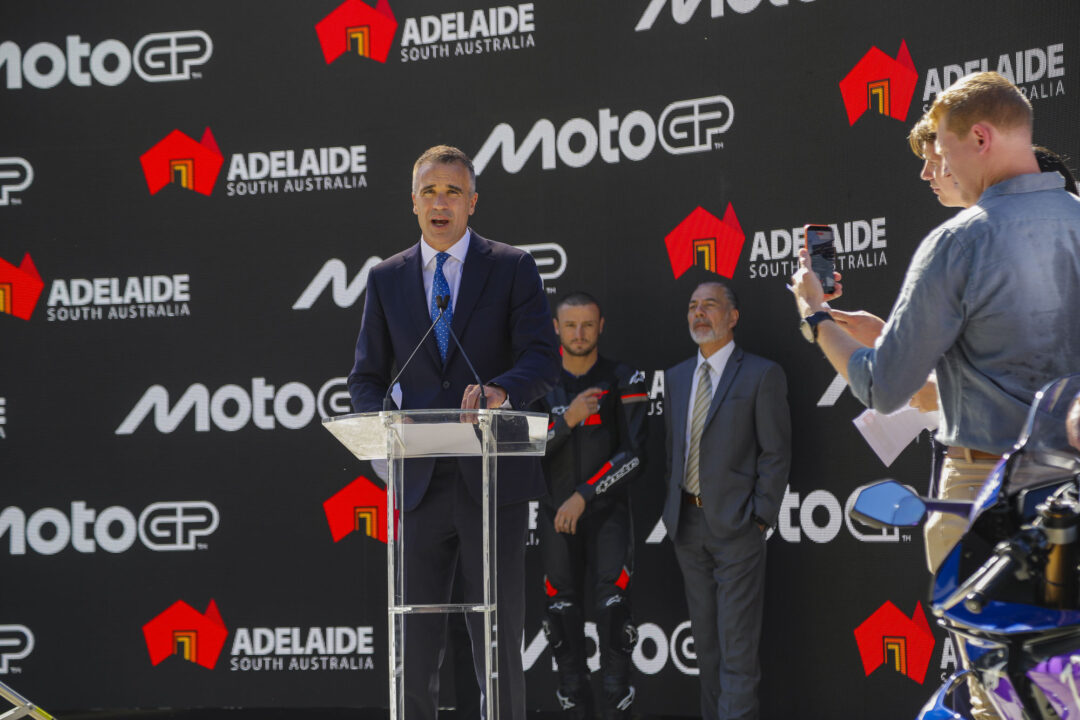
The Premier of South Australia, Peter Malinauskas, added:“This is a major coup for South Australia and yet more evidence our state has real momentum. “We are now competing with the rest of the nation for the world’s best events – and winning. Hosting the world’s first MotoGP race on a street circuit will give Adelaide a truly unique offering that is sure to attract visitors from interstate and overseas.”
Miller commented that the issues of holding a MotoGP race on a street circuit were being overblown by commentators. “It’s not a street circuit really in the big scheme of things,” he said. “I mean, it’s a race circuit that’s put in the middle of the city. I think the words ‘street circuit’ get misconstrued a little bit. I think it’s going to be an amazing event.
“There won’t be a concrete barrier and an air fence in touching distance. I fully trust Carlos [Ezpeleta, MotoGP chief sporting officer] and the calculations.”
“They have an incredible array of knowledge when it comes to crashing and how much time you need to stop, and all of the different data from the g-force sensors, the airbag leather suits and so on.
“The majority of the new tracks that we’ve gone to have been designed with that in mind.
“The worry of hitting a wall is always there when your brakes go or whatever, but in terms of a normal day-to-day crash, no.”
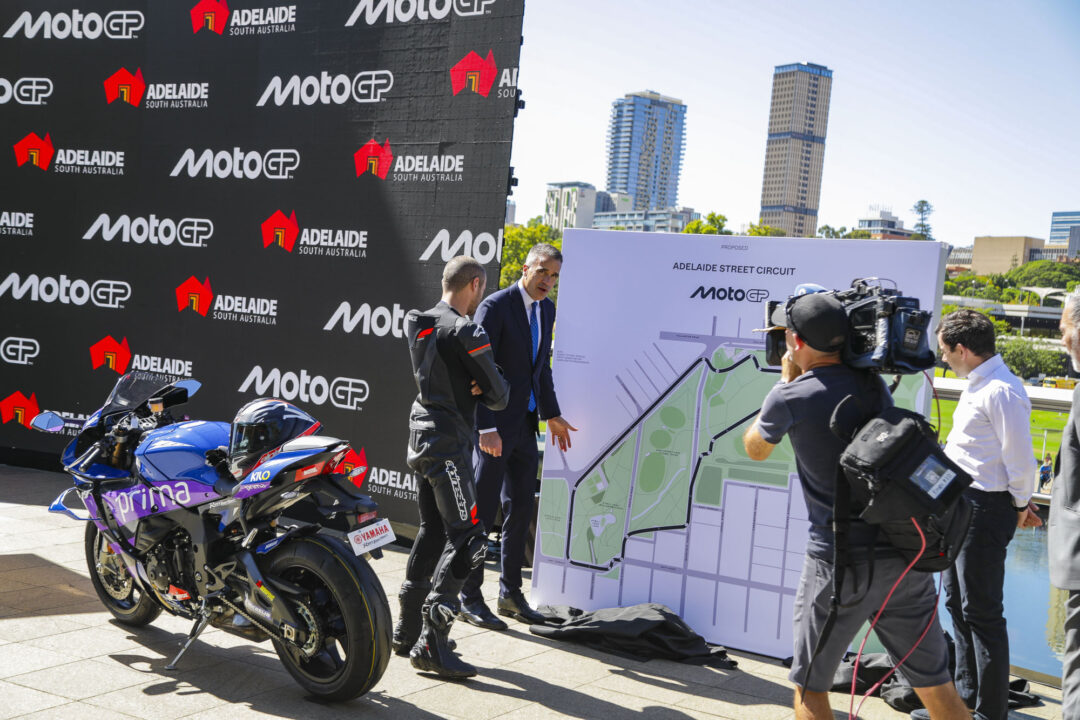
Just The Beginning?
I guess we could have deduced that MotoGP as we know it is going to change when the announcement was made that Dorna Sports, S.L. was going to be known as MotoGP Sports Entertainment Group.
As has happened in Formula 1, they will turn what was a premier racing championship into a global sports entertainment platform. And that means, unfortunately, it’s likely going to be more about the show than the racing.
Formula 1 under Liberty is the template. Move races closer to population centres. Maximise hospitality, corporate activation and media exposure. Build the event around the spectacle.
With the LIV Golf tournament in Adelaide smashing records by drawing in over 115,000 fans, the draw of having an attraction as exciting as MotoGP so close to a population of 1.4 million people is almost certainly going to attract more than Phillip Island ever could.
But will the racing be as good? We’ll no longer get to see those iconic shots of the bikes battling for position with the Bass Strait in the background or bikes sliding over Lukey Heights.
With Adelaide signing a 6-year contract with Liberty for the rights to host the Australian GP, all stakeholders must ensure they cannot only fulfil all FIM safety regulations to hold a race, but also improve attendance and event visibility.
Yet, if you take a look at the video below of the circuit from the perspective of a race car, there seems to be quite a lot of areas where the issue of colliding with trees, buildings and other road furniture is going to be extremely difficult to mitigate. Bikes are not like cars, where a solid wall situated right next to the racetrack offers the safest barrier. Think of the Mountain section at Bathurst, where cars regularly collide with the walls and simply slide along while the driver is enclosed in a protective safety cell. Unfortunately, riders simply have a leather suit and a crash helmet to protect them from injuries from sliding. They have zero protection from impacts. How the organisers will give enough run-off for bikes is yet to be seen.
And then what about the riders? The premier class has actively moved away from road circuits over the past 45 years, following regular fatalities among riders and spectators, and has moved to purpose-built circuits where safety is much easier to control. Yes, modern technology, computer simulations and technical experts will undoubtedly work hard to make the Adelaide street circuit as safe as possible. But can it ever be as safe as a purpose-built racetrack that has been designed to modern standards? We can only wait and see…